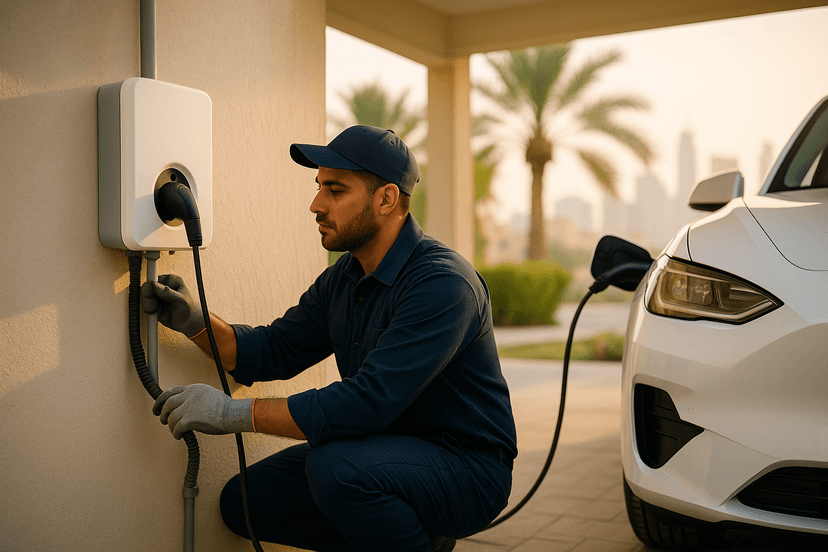



A home maintenance contract in Dubai — the annual maintenance contract, or AMC — bundles callouts, AC servicing and small repairs into one yearly fee. One UAE quote-comparison service, Bestimate, publishes Dubai home maintenance contracts from AED 1,200 a year for a small apartment on basic reactive support. What a contract excludes decides the real cost.
Your AC quits on an August night and the bedroom is already unbearable. You call the number on the contract you signed in spring, and a voice tells you the technician is booked out for days. When he finally turns up, he pronounces the compressor dead — and the paperwork you never read says parts are not covered. You paid for a whole year of protection just to be told no, in the one week of the year you actually needed a yes.
An annual maintenance contract is an insurance product wearing the clothes of a service. Four lines in the wording decide whether the fee buys you anything at all: how many callouts you get, whether parts are covered or only labour, how many preventive AC visits are scheduled and what each visit includes, and what the provider owes you when a promised response time is missed. Everything else in the brochure is decoration.
How much does a home maintenance contract cost in Dubai?
Pricing for a Dubai home maintenance contract is built from the inputs before anyone writes a number down: the size and type of the property, how many AC units and water heaters sit inside it, whether spare parts are covered or only the labour to fit them, and how many callouts a year the fee entitles you to.
Bestimate's published AED 1,200 a year describes a small apartment on basic reactive support — the thinnest version of the product, where someone answers the phone and sends a technician after something has already broken. Each step away from that thin version tends to move the fee up, because it moves risk from you onto the provider.
A villa with several AC units, a booster pump, a water tank and outdoor lighting carries more equipment, more visits and more chances of failure than a one-bedroom flat. Adding parts coverage moves the expensive half of a breakdown onto the provider's books. A written response-time commitment costs a provider standby capacity.
What is included in an annual maintenance contract in Dubai?
An annual maintenance contract in Dubai bundles routine servicing and reactive repairs across a named list of systems, and the list itself is the product. Anything outside the list is likely to be billed as a normal paid job.
Ask which of these core systems the contract actually names:
- Air conditioning — scheduled servicing plus reactive repair when a unit stops cooling.
- Plumbing — dripping taps, blocked traps, cistern faults, water heater problems.
- Electrical — faulty switches and sockets, light fittings, tripping breakers.
- Handyman and carpentry — door alignment, cupboard hinges, fixings, minor fittings.
- Finishes — small paint or sealant touch-ups after a repair.
- Villa extras — pumps, water tanks and outdoor points, where the property has them.
Two Dubai contracts naming the identical systems can still deliver completely different service, because the naming is the easy part. Air conditioning carries the most weight of anything on the list, and our AC maintenance in Dubai guide sets out the servicing schedule a serious contract should commit to on paper.
What is usually excluded from a Dubai maintenance contract?
Exclusions are where an AMC quietly stops being cover and starts being a discount card. The table below shows one common split between work absorbed by the annual fee and work billed on top of it — confirm every row against the wording you are actually being offered.
Reactive or preventive: which Dubai maintenance contract are you buying?
A reactive Dubai maintenance contract buys you a phone number and a technician after a failure. A preventive contract buys you a schedule — dated visits, a defined task list per visit, and the assumption that a serviced system fails less often than a neglected one.
The reactive-versus-preventive distinction matters more in Dubai than in a mild climate, because AC equipment here runs hard for months without a break and dust loads filters hard. A cooling system nursed through the shoulder season behaves differently in peak summer than a cooling system nobody has opened since the day it was installed.
A contract sold as preventive can still be a hybrid: a small number of scheduled visits plus reactive callouts for anything that breaks in between. Buying a hybrid is fine — buying a hybrid while believing you bought full preventive cover is how homeowners end up furious in August. Our Dubai home maintenance calendar shows which jobs belong in which month, which makes checking a provider's proposed schedule straightforward.
Is an AMC worth it for a Dubai apartment?
For a small, newly handed-over apartment with one or two AC units and no history of faults, paying per callout is often the honest answer. You pay when something breaks, you choose the technician for the specific job, and no annual fee quietly renews while nothing goes wrong.
A contract starts earning its fee once any of these are true:
- The property is a villa, or an apartment with several AC units and a heavy plumbing load.
- Equipment is ageing, and small faults have started arriving in clusters.
- You want scheduled preventive servicing to happen without you chasing anyone.
- You cannot afford to spend a summer evening cold-calling technicians who are already booked.
- You rent the place out and need a single accountable number for the tenant to call.
A useful test before signing: add up what you actually spent on repairs across the last twelve months, then compare against the fee being quoted and the exclusions attached to it. Where the sums land close together, the contract is buying convenience and response speed rather than savings — a legitimate purchase, but worth making with open eyes.
Who should hold the maintenance contract in Dubai, the landlord or the tenant?
Read the maintenance clause in your tenancy agreement before either side buys an AMC.
Where a landlord holds a contract, it usually covers the property's fixed systems, protecting an asset they own and keeping tenants from arranging unvetted work on AC and plumbing. Tenants who buy their own cover are buying speed and control — a contract in their own name means calling a provider directly instead of waiting on an owner overseas.
Two failure modes are worth guarding against. A tenant pays for an AMC duplicating cover the landlord already holds, and neither party notices for a year. Or both assume the other arranged something, nobody did, and the discovery arrives on the hottest night of the year with no contract to call. Confirming in writing who holds what costs one message.
What should you check before signing an AMC in Dubai?
Work through the same list with every Dubai provider, in the same order, and weak contracts eliminate themselves:
- Covered systems, named. A written list of systems and equipment, not a category heading.
- Callout allowance. A stated number of reactive callouts, plus what a callout beyond the allowance costs.
- Preventive visits. A stated number of scheduled visits and the task list performed on each one.
- Parts treatment. Covered, capped or excluded — and how replacement parts get priced when billed.
- Response commitment. A response time in hours, and the remedy owed to you when the provider misses one.
- Licensing and technicians. A licensed company, with named trades handled in-house rather than passed to whoever is free.
- Renewal and exit. Notice period, refund position on unused months, and whether renewal happens automatically.
TaskRight is a verified, zero-commission home services platform in the UAE, which means every provider you meet through us keeps 100% of what you pay them — no platform cut is buried inside your annual fee. RightPro-verified companies are checked before they can quote, quotes are free, and you hire and pay the provider direct with nothing sitting in the middle of that relationship.
AC is where a Dubai maintenance contract earns or loses its money, so start there: describe your property and the cooling cover you want once, and get free quotes from verified Dubai AC pros on scope you defined yourself rather than on scope a salesperson defined for you.
👉 Find verified AC pros in Dubai →
Frequently asked questions about home maintenance contracts in Dubai
Does a home maintenance contract in Dubai cover AC parts?
Parts coverage sits on a separate line from labour in a Dubai home maintenance contract,. Read the parts clause before signing: ask whether compressors, motors, pumps and control boards are covered, capped or excluded outright, and ask how replacement parts get priced when a provider bills for them separately.
How many AC services a year does a Dubai maintenance contract include?
Service frequency varies by contract, so a Dubai maintenance contract should state the number of preventive AC visits in writing instead of promising regular servicing. Ask what each visit actually covers, because coil cleaning, chemical washes and duct cleaning can be charged as extras, and ask what remedy applies when a scheduled visit gets missed.
Can you cancel a home maintenance contract in Dubai?
Cancellation of a home maintenance contract in Dubai depends on the termination clause inside the contract, so read the clause before you sign anything. Check the notice period, whether unused months are refunded, whether renewal happens automatically without a reminder, and exactly how notice must be delivered for a provider to accept it.
Is a maintenance contract in Dubai better than paying per callout?
Paying per callout suits a small Dubai apartment with newer equipment and few faults, because money leaves your account only when something breaks. A maintenance contract in Dubai earns its fee on larger properties, ageing equipment, or when you want scheduled preventive visits and a guaranteed response rather than hunting for an available technician mid-summer.
What should a Dubai home maintenance contract include in writing?
A Dubai home maintenance contract should name the covered systems, the callout allowance, the number of preventive visits, the response-time commitment and the remedy owed when a response is missed. Written exclusions matter equally: parts, consumables, chargeable extras, out-of-hours callouts and any work the provider is not licensed to carry out.
Related reading:
Last updated: September 2026