

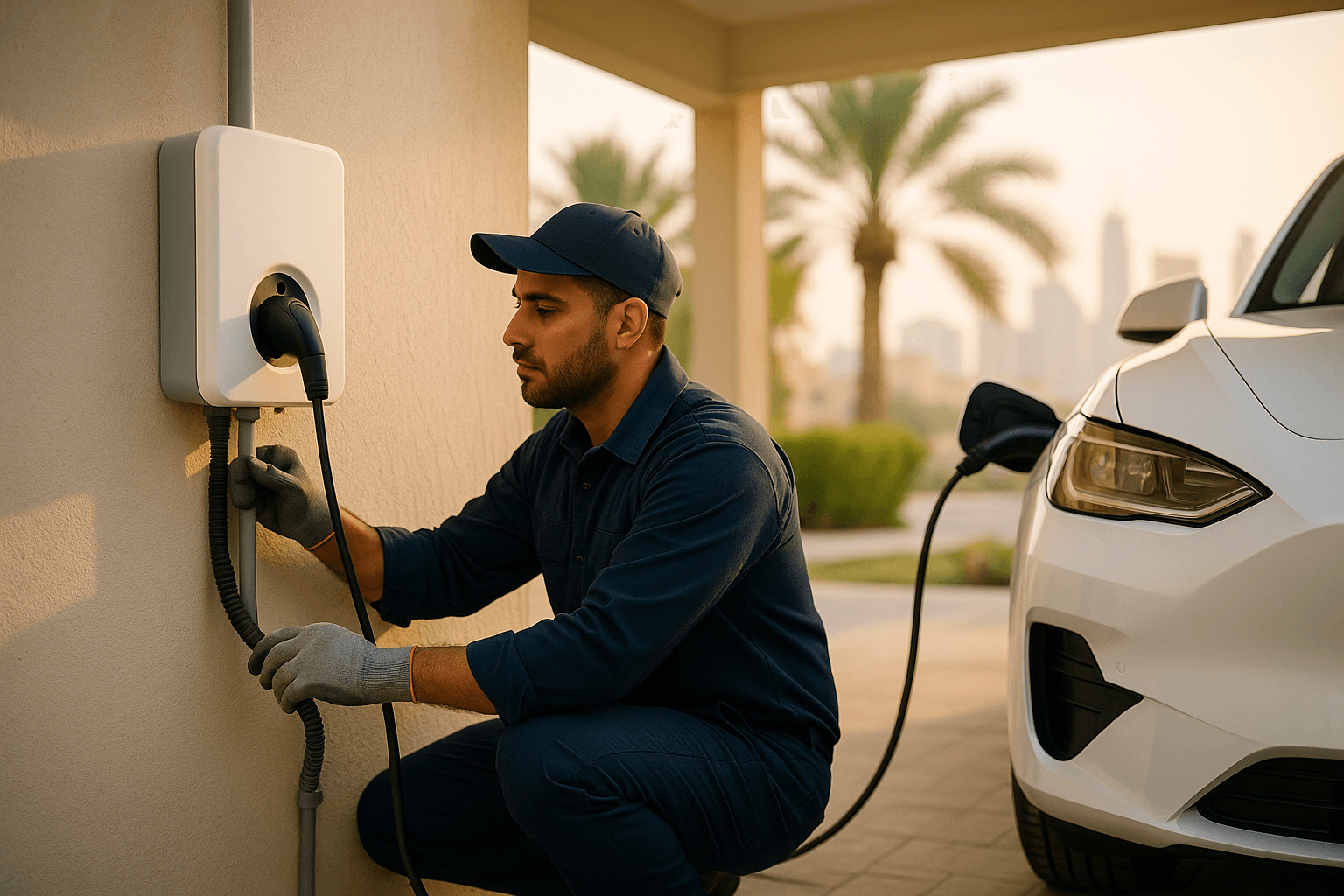
EV charger installation in Dubai starts from AED 1,199 for a standard residential install, with the charger unit priced separately. DEWA states that DEWA-approved electrical contractors should be used for any electrical equipment installed in Dubai, including home charging stations, so the installer matters as much as the box.
Then you collect three quotes and they read like three different countries. One says twelve hundred, one says four thousand, one says fifteen. Nobody explains why, and you are left guessing whether you are being overcharged or under-scoped. You are not comparing prices. You are comparing three different jobs that have been given the same name.
This guide separates them, using DEWA's own published rules and tariffs plus the manufacturers' own specifications, so you can tell which quote covers what before you pay for any of them.
How much does it cost to install an EV charger in Dubai?
EV charger installation in Dubai starts from AED 1,199. AED 1,199 is the published starting figure of the installer ranking first on this search in Dubai, and the scope it names is a standard residential installation: wall mount, wiring, breaker and testing, with electrical upgrades quoted separately.
The charger unit is not in that figure, and that omission is the source of most of the confusion in this market. An installation-only quote and a supply-and-install quote are different products, and a basement run in an apartment building with management approvals is a third product again.
- Does the price include the charger unit, or installation only?
- How many metres of cable run are included, and what happens beyond that?
- Are electrical upgrades and any building approvals inside the price or outside it?
Can a normal electrician install an EV charger in Dubai?
DEWA answers this one directly. Its own guidance states that home chargers can be installed by a third party at customers' premises, behind the customer's meter, in the same manner as other home appliances, and that DEWA-approved electrical contractors should be used for the installation of any electrical equipment within the emirate of Dubai, including home charging stations.
Two things follow from that sentence. The charger is treated as a normal appliance sitting behind your meter rather than as a piece of DEWA network equipment. And the contractor doing the work is the part DEWA has an opinion about.
Our guide to hiring an electrician in Dubai covers the checks that apply to electrical work generally, and they apply here too.
Do you need DEWA approval to install a home EV charger?
The honest answer is that DEWA's homeowner guidance does not name an approval step, and Dubai installers disagree about whether one applies. One installer states that most residential installations with adequate panel capacity do not require a separate DEWA no objection certificate. Another states flatly that DEWA approval is required.
What DEWA does publish is a separate rule with a different audience. Directive Number 1 of 2017, issued by the Chairman of the Dubai Supreme Council of Energy, requires all public and private organisations and developers in Dubai to get DEWA approval before establishing, installing, operating or maintaining any EV charging station.
Read the audience of that directive carefully, because several Dubai pages do not. The wording binds organisations and developers. The homeowner-facing guidance on the same DEWA page contains no approval step at all, only the approved-contractor requirement. Anyone telling a villa owner that Directive 1 of 2017 obliges them personally is stretching it.
The workable position: treat the approval question as depending on your scope, ask the installer to state in writing which approvals the job needs and who obtains them, and get that before the work starts. Read DEWA's own page at DEWA's EV charging guidance rather than a summary of it.
Is DEWA EV charging free, and what does charging at home cost?
DEWA EV charging is not free. Since 30 September 2024, under Cabinet Decision No. 81 of 2024, registered users of the EV Green Charger service pay AED 0.70 per kWh plus VAT for AC charging and AED 1.20 per kWh plus VAT for DC charging at public stations.
Home charging is billed differently, on your normal DEWA bill at standard residential rates. Three published DEWA figures set the comparison.
The residential slab tariff is banded by total monthly household consumption rather than by what the car uses, so the slab a home sits in depends on everything else plugged in too. Our comparison of Dubai and Abu Dhabi electricity tariffs sets out how the slabs work and where the fuel surcharge lands.
Should you get a 7.4 kW or a 22 kW charger in Dubai?
Your electricity supply decides it, not the charger you buy. Wallbox states that a Type 2 connector reaches a maximum of 22 kW on three phase and 7.4 kW on one phase. Easee gives the same pair from the other direction: up to 22 kW at 32 amps on a three-phase circuit and up to 7.4 kW at 32 amps on a single-phase circuit.
The same 32 amp charger therefore behaves in two different ways.
Which means the first question to any Dubai installer is not which brand to buy but whether your property has a three-phase supply and whether the existing board can carry the load. A single-phase villa that buys a 22 kW box has bought a 7.4 kW charger with a bigger label on it.
Why do Dubai EV charger quotes differ so much?
Dubai EV charger quotes differ mostly on scope and on distance. The scope half is whether the charger unit is inside the price. The distance half is the route the cable has to take from your distribution board to the parking bay, which is charged per metre beyond whatever length the package includes.
Installers describe the same drivers in their own words: cable run length, panel capacity, building type, protection devices, conduit, and any civil work needed to hide the cable through a wall, a ceiling void or interlock paving. None of those are visible from a phone call, which is why a site survey precedes any honest fixed price.
- Charger unit included, or installation only.
- Metres of cable included, and the rate beyond it.
- Surface-mounted conduit versus armoured cable and buried or chased routes.
- Whether the existing board needs upgrading before anything can be connected.
What is different about installing an EV charger in a Dubai apartment?
An apartment charger is a longer job with more people to satisfy. The cable run from the building supply to an allocated basement bay is far longer than a villa carport run, and the bay is common property rather than yours, which brings building management into the decision.
Every Dubai installer we checked states that building management approval or a no objection certificate is needed for a charger in a shared building. The no-objection requirement is an installer claim rather than a rule we could trace to a published authority document, so treat it as the market's consistent practice and ask your building management directly.
For metered apartment installs the billing question comes first, before the electrical one: establish which meter the charger will sit behind, because that decides who receives the bill for every kilowatt-hour the car takes.
How do you get EV charger quotes in Dubai without paying a commission?
Give every installer the same brief so the quotes become comparable: villa or apartment, single or three phase if you know it, the approximate distance from the board to the parking bay, and whether you want the charger supplied or have already bought one. Quotes written against the same brief can be read side by side.
Then insist each one states the DEWA-approved contractor position in writing, names what the price includes, and says what happens if the cable run turns out longer than assumed. The installers who answer those in writing are the ones who have done this before.
TaskRight is a verified, zero-commission home services platform in the UAE. Describe the job once and RightPro-verified electrical companies come back to you directly. Nobody takes a cut of their work, so nothing gets added to your price.
👉 Get EV charger installation quotes in Dubai →
You can also browse electrical companies in Dubai on TaskRight, or read our guide to home automation costs in Dubai if the charger is one part of a bigger job.
Frequently asked questions about EV charger installation in Dubai
How much does it cost to install an EV charger in Dubai?
EV charger installation in Dubai starts from AED 1,199 on the published price of the highest-ranking Dubai installer, covering a standard residential install with wall mount, wiring, breaker and testing. The charger unit itself is priced separately, which is the single biggest reason quoted figures look so far apart.
Can a normal electrician install an EV charger in Dubai?
DEWA states that DEWA-approved electrical contractors should be used for the installation of any electrical equipment within the emirate of Dubai, including home charging stations. A general handyman is outside that wording, so ask any Dubai installer to evidence its DEWA-approved contractor status before booking.
Is DEWA EV charging free in Dubai?
DEWA EV charging is not free. Under Cabinet Decision No. 81 of 2024, registered users of the EV Green Charger service have been charged AED 0.70 per kWh plus VAT for AC charging and AED 1.20 per kWh plus VAT for DC charging at public stations since 30 September 2024.
What does it cost to charge an electric car at home in Dubai?
Charging at home is billed on the normal DEWA bill at standard residential rates, which DEWA publishes as a slab tariff beginning at AED 0.230 per kWh, plus a fuel surcharge and 5 percent VAT. Which slab a household lands in depends on its total monthly consumption, not on the car alone.
Should I get a 7.4 kW or a 22 kW charger in Dubai?
The supply decides it rather than the charger. Wallbox and Easee both state that the same 32 amp Type 2 charger delivers 7.4 kW on a single-phase supply and 22 kW on a three-phase supply, so a Dubai home on single phase cannot reach 22 kW by buying a bigger box.
Why do Dubai EV charger quotes vary so much?
Dubai EV charger quotes vary because they describe different jobs. Some figures cover installation only, some include the charger unit, and some cover an apartment basement run with building approvals. Cable run length from the distribution board to the parking bay moves the labour figure more than the brand does.
Do I need DEWA approval to install a charger at home in Dubai?
DEWA's homeowner guidance names an approved contractor requirement and no approval step, while Dubai installers contradict each other on whether approval is needed. Treat the answer as depending on your scope, and get it in writing from the installer before work starts rather than after.
Last updated: September 2026. DEWA rates, tariffs and guidance re-verified against dewa.gov.ae on 15 September 2026.