

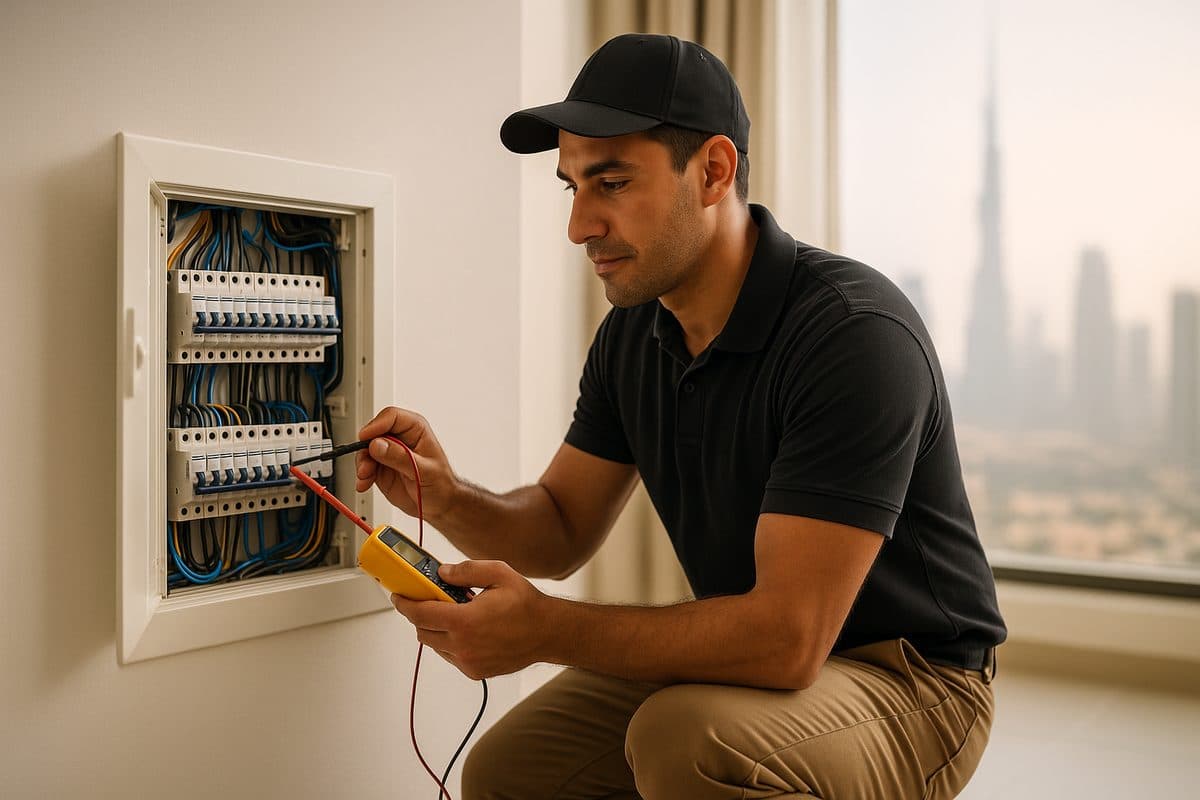
The electrician cost in Dubai runs from a call-out charge of AED 120–150 for a quick visit, to AED 150–350 an hour for fault repair, up to AED 3,000–12,000 for a full distribution board — and the number you actually pay depends on one thing most homeowners never check: whether the job legally needs a DEWA-approved electrician or just a licensed handyman.
Fitting a light, a socket or a ceiling fan is a small, priced-per-unit job. Touching your meter, your supply, or your main board is a DEWA-regulated job that a "cash-in-hand" guy with no licence has no business doing. Confuse the two and you either overpay for a five-minute fix or you void your insurance on work that was never signed off.
This guide gives you the real 2026 Dubai rates — call-out, hourly, per-point and per-unit — plus exactly when the law requires a DEWA-registered contractor, so you walk into every quote knowing what the work is worth and who is allowed to do it.
How much does an electrician cost in Dubai?
Here are the real 2026 Dubai ranges for the jobs homeowners actually book. Small fittings are priced per unit; fault-finding is priced by the hour; big supply work is quote-only.
⚡ Quick Summary
- Most homes pay a call-out of AED 120–150 that covers the first 30–60 minutes.
- Fault repair is billed at AED 150–350/hour; evenings, weekends and holidays add roughly 25–60%.
- Lights, sockets and fans are per-unit and can be done by any licensed electrician.
- Anything touching the DEWA supply, meter, new circuits or main board legally needs a DEWA-approved contractor.
How do electricians in Dubai price a job?
There is no single "electrician hourly rate in Dubai" because good electricians price three different ways depending on the work. Understand which model applies and you stop overpaying.
- Call-out charge. A flat fee of AED 120–150 (some firms charge up to AED 250) that gets the electrician to your door and usually covers the first 30–60 minutes of diagnosis. This is the "electrician call out charge in Dubai" you'll see quoted first.
- Hourly rate. Once the call-out time is used up, labour runs AED 150–350/hour. Residential fault-finding sits at the lower end; complex or commercial work sits higher, and after-hours emergencies can hit AED 250–400/hour.
- Per-point / per-unit. For fitting work — a light, a socket, a fan, a spotlight — a fair electrician quotes a fixed price per unit, materials on top. This is almost always cheaper than paying hourly for the same job.
💡 The trick that saves you money
If you have five small jobs, don't call five times and pay five call-outs. Batch them into one visit. One AED 130 call-out plus per-unit prices on the rest will always beat paying the minimum charge again and again.
What do common electrical jobs cost in Dubai?
Prices below are for supply-and-fit on standard fittings. Premium chandeliers, imported fixtures, or awkward high ceilings in a double-height villa majlis push the top of each range.
- Light or spotlight fitting — AED 150–500. Swapping a fixture, hanging a pendant, or installing recessed downlights. Multiple lights in one visit drop the per-unit price.
- Socket or switch replacement — AED 150–500. Replacing a cracked, sparking or dead socket. Adding a brand-new socket that needs a new spur costs more because it's part-rewiring.
- Ceiling fan install — AED 200–600. Higher in Dubai than most cities because summer heat means fans run hard; a proper fixing into a concrete slab and correct balancing is worth paying for.
- Room rewiring — AED 400–900 per room. Replacing old or overloaded wiring within a room. In older Deira and Bur Dubai buildings this is common and should always be done by a licensed electrician.
- Electrical inspection / safety certificate — AED 150–800. A full check of your board, circuits and earthing. Worth it before buying a resale villa or after a spate of tripping.
When do I legally need a DEWA-approved electrician?
This is the part that protects you. In Dubai, the Dubai Electricity and Water Authority (DEWA) sets and enforces the electrical standards for every property. Some work you can hand to any licensed electrician. Other work is DEWA-regulated and must be done by a DEWA-approved (registered) electrical contractor, then inspected and signed off by DEWA.
The rule of thumb: if the work touches your supply, meter, load or main board, it needs a DEWA-approved contractor and a DEWA sign-off. If it's downstream of your board — a light, a socket, a fan — a licensed electrician is fine. You can verify a contractor's DEWA registration before you hire, and any honest firm will give you their registration details without hesitation.
⚠️ The "cash-in-hand, no licence" trap
The AED 80 guy from a building WhatsApp group has no trade licence, no DEWA registration and no accountability. If his wiring causes a fire, your home insurance can be voided because the work was never certified. If he touches your board or meter without DEWA sign-off, you carry the compliance risk, not him. Cheap today, ruinous the day something goes wrong.
Which electrician licence actually matters in Dubai?
There are two separate things to check, and people constantly confuse them:
- A DET trade licence. A legitimate electrical company holds a Dubai Department of Economy and Tourism (DET, formerly DED) trade licence for electrical work. This is what makes the business legal to operate and gives you legal recourse.
- DEWA approval / registration. Separate from the trade licence, this is DEWA's certification that the contractor is competent to carry out supply, meter and distribution-board work. Required for any DEWA-regulated job.
💡 One thing Ejari is not
Ejari is rental-contract registration. It is not a trade licence and it never authorises any electrical work or contractor. Anyone who waves "Ejari" at you as proof they're licensed doesn't understand the system. The trade licence is a DET licence; the electrical competency sign-off is DEWA's.
Why does electrical work cost more in a villa than an apartment?
The per-unit rates are similar, but the surrounding rules and job sizes are not.
- Apartments. Your building management usually requires a fit-out NOC and an approved contractor for anything beyond swapping a fixture. Towers restrict noisy work to set weekday hours, which can stretch a rewiring job across more days.
- Villas. Bigger loads, more circuits, garden and pool lighting, and the summer AC demand that pushes boards to their limit — villa electrical work runs larger. Communities like Arabian Ranches, the Springs and Dubai Hills see frequent load upgrades and DB changes, all of which are DEWA-regulated. Villas are also where EV home chargers get installed.
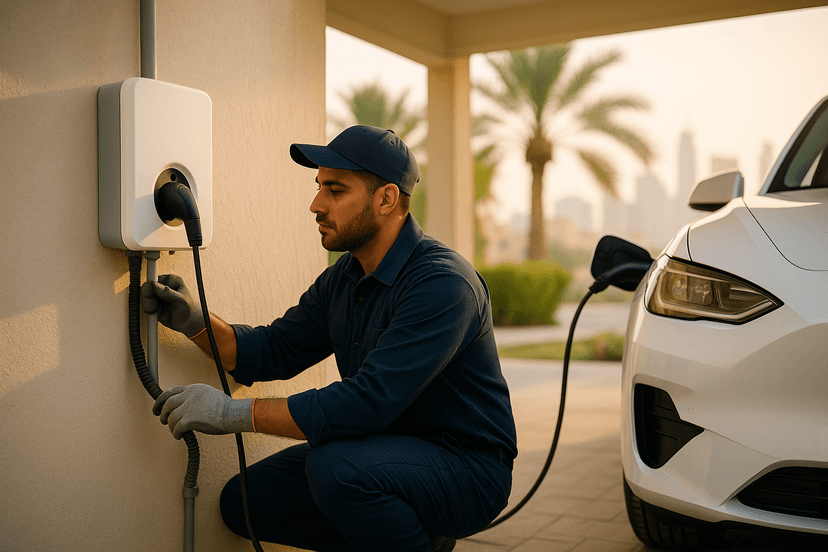
How much does EV charger installation cost in Dubai?
A home EV charger in Dubai typically costs AED 1,599–4,000 installed, depending on the charger, the cable run from your board to the parking bay, and whether your load needs upgrading. A standard 7–11 kW wall charger fully charges most cars in 4–6 hours.
Because the charger connects to your supply, it must be installed by a DEWA-registered installer under DEWA's EV Green Charger initiative and meet Dubai Municipality standards — not the cash-in-hand electrician. DEWA runs incentives for villa owners from time to time, so check the current EV Green Charger terms with DEWA before you buy your unit.
A Worked Example (So the Numbers Make Sense)
Say you've just moved into a 1-bed apartment and have a snag list: two dead sockets, a dining pendant to hang, and a bathroom exhaust fan to replace. Here's the honest maths for one visit.
That totals AED 860 for the whole visit — and notice the sanity check: the call-out plus three per-unit prices add up cleanly. If an electrician quotes you AED 2,500 for that same snag list, or can't itemise it line by line, you're being padded.
What hidden costs get added to an electrician's bill in Dubai?
- Materials on top of labour. "AED 150 to fit" often means labour only. Ask whether the fixture, cable, socket and back-box are included or billed separately.
- After-hours surcharge. Evenings, Fridays and public holidays add roughly 25–60% to the hourly rate. A "tripped board" at 11pm costs more than the same fix at 11am.
- Building NOC and approvals. In apartments, layout or load changes need a building NOC before work starts, and DEWA-regulated work needs DEWA sign-off — real line items, easy to forget.
- The "while I'm here" upsell. Legitimate if your wiring is genuinely unsafe; a scam if a five-minute socket swap suddenly becomes a "full rewire you urgently need." Get it in writing before you agree.
How do I know if a Dubai electrician is overcharging me?
How do I get a fair electrician quote in Dubai?
✅ The 4-step fair-quote test
- Confirm the licence. DET trade licence for the business, plus DEWA registration if the job touches supply, meter or the main board.
- Ask which pricing model applies. Per-unit for fittings, hourly for fault-finding, quote-only for DB work. Match the model to the job.
- Get it itemised. Labour and materials as separate lines, so you can sanity-check the total against the parts — the way the worked example above adds up.
- Batch small jobs. One call-out, several per-unit fixes, one invoice. You pay the minimum charge once.
Frequently Asked Questions
How much does an electrician cost in Dubai?
Expect a call-out charge of AED 120–150 that covers the first 30–60 minutes, then AED 150–350 per hour for fault repair. Small fittings like lights, sockets and fans are priced per unit at roughly AED 150–600 each. Big supply or distribution-board work is quote-only.
What is the electrician hourly rate in Dubai?
AED 150–350 an hour in 2026. Residential fault-finding sits at the lower end; complex or commercial work is higher, and after-hours emergencies can reach AED 250–400 an hour.
Do I need a DEWA-approved electrician in Dubai?
For anything touching your DEWA supply, meter, new circuits, a load increase or the main distribution board — yes. That work must be done by a DEWA-approved (registered) contractor and signed off by DEWA. For downstream jobs like fitting a light, socket or fan, any licensed electrician is fine.
How much does house wiring cost in Dubai?
Room-by-room rewiring runs roughly AED 400–900 per room. A full-house rewire is quote-only and depends on size and circuits; because it affects your load and board, it's DEWA-regulated and needs an approved contractor.
How much is EV charger installation in Dubai?
A home EV charger typically costs AED 1,599–4,000 installed, depending on the unit and the cable run. It must be fitted by a DEWA-registered installer under the EV Green Charger initiative; check DEWA for current villa-owner incentives.
Is a cheap unlicensed electrician worth the risk?
No. An unlicensed, cash-in-hand electrician gives you no warranty and no accountability, and faulty uncertified work can void your home insurance. On DEWA-regulated jobs, the compliance risk lands on you, not on them.
Pay for the Fix, Not the Padding
The difference between a fair electrician bill and a fleecing isn't the job — it's whether you know the call-out, the hourly rate, and which work legally needs a DEWA-approved contractor. Now you do.
The last step is finding electricians who price honestly because they've been vetted to. Every electrician on TaskRight is RightPro-verified, so you compare real, itemised quotes instead of guessing who's padding the bill.
TaskRight is a verified, zero-commission home services platform in the UAE. Every electricians you see is RightPro-verified, the quotes are free, and you hire and pay them direct — we never take a cut of your job. Describe the job once, compare real itemised quotes side by side, and choose the electrician you trust.
👉 Find verified electricians in Dubai →
Last updated: August 2026. Prices reflect 2026 averages and may vary by provider, scope, and season. DEWA approval requirements and building NOC rules differ by property and community — always confirm with a DEWA-registered contractor before any work touching your supply, meter, or main board.