

Home automation in Dubai is priced as a system, not as a shopping list, and the published entry point is modest: one UAE home-services marketplace, ServiceMarket, publishes smart home system costs in Dubai starting from AED 5,000 for a basic setup. Whole-home wiring, control panels and programming push a real quote well above any starting price.
Here is how the story usually ends in a Dubai villa. The lights work beautifully from one phone. The curtains respond to a scene nobody can edit. The AC schedule was set up on the installer's own account, using the installer's own email address, and the touch panel in the hallway has been showing a spinning circle since the Wi-Fi router was replaced. You message the company. Two ticks, no reply. You message again. The number is still on WhatsApp but the business behind it has moved on to the next fit-out, and the system you paid for now belongs, in every practical sense, to somebody you cannot reach.
Home automation fails in Dubai for the same reason bathrooms leak: the expensive part was never the hardware. Programming, documentation and handover decide whether you own a smart home or rent one from a stranger.
How much does home automation cost in Dubai?
ServiceMarket publishes smart home system costs in Dubai starting from AED 5,000 for a basic setup. Scope sets the number, and scope in Dubai varies wildly. A studio in Business Bay with app-controlled lighting and a single smart thermostat is a small job. A large villa in Arabian Ranches with lighting scenes in every room, motorised curtains, zoned AC control, distributed audio, an intercom and a camera feed on one screen is a different trade altogether.
Several things move a Dubai quote more than the brand printed on the box: how many lighting circuits and AC zones are being controlled, whether the walls are open or already finished and painted, how many physical control points you want on the walls, and how many hours of programming are needed so that one keypad press does several things at once.
Labour is the line a quote can hide. Hardware can be priced straight from a catalogue. Commissioning, scene programming, network configuration and the afternoon spent teaching a household how to use the system cannot, so a quote that lists devices and then gives one lump sum for "installation" is silent about the hardest part of the job.
Per-room pricing is another trap. Comparing per-room prices across two installers compares two different products wearing the same label.
What does a smart home system in Dubai actually include?
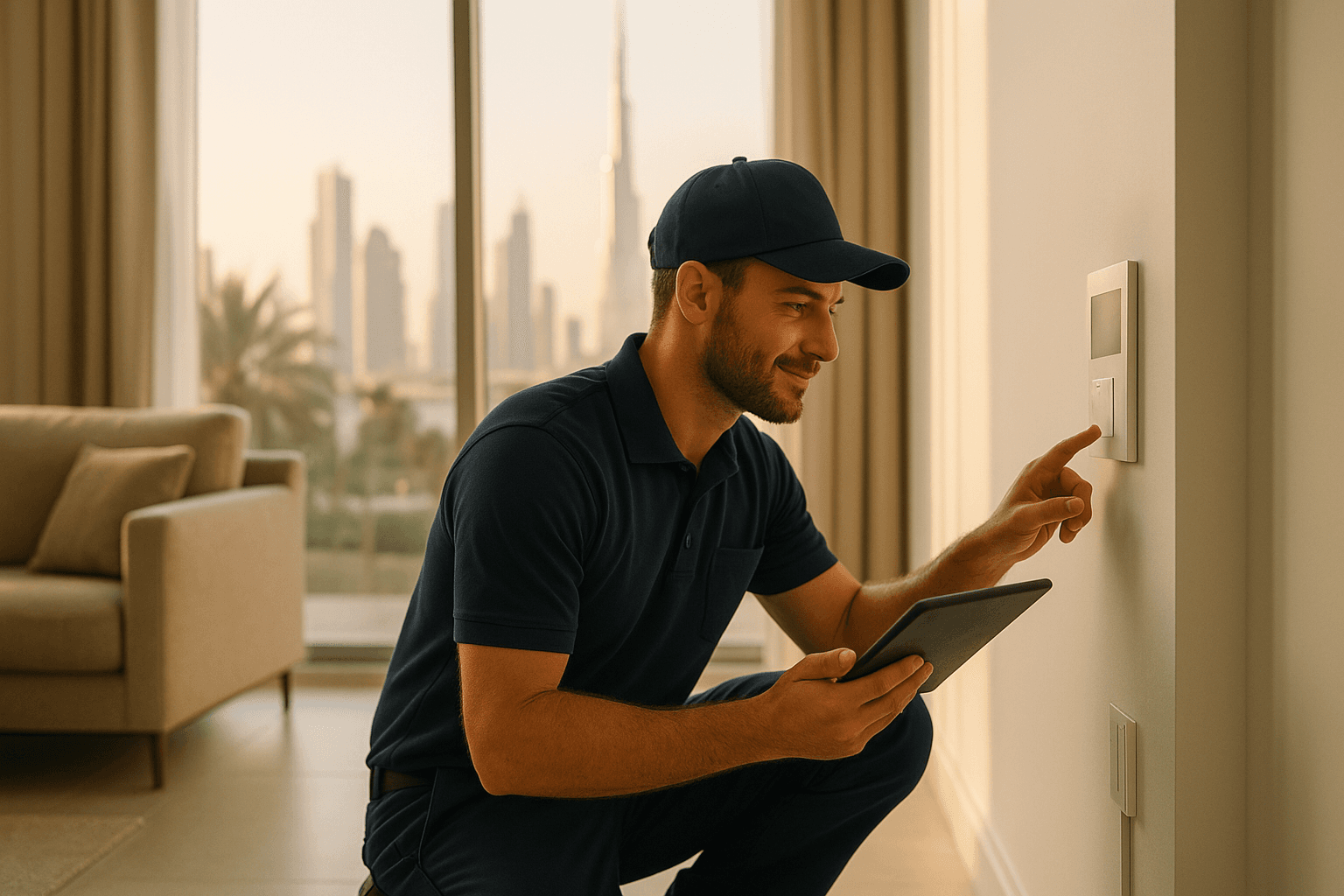
A whole-home system in Dubai stacks layers on top of each other, and a proposal that skips a layer comes back later as a variation order. The first layer is the network: cabling, switches and access points strong enough to carry the whole house. Layer two is the controlled hardware itself, meaning dimmer modules, relays, curtain motors, thermostats and sensors. Layer three is the control surface, meaning wall keypads, touch panels and the phone app. Layer four is the programming that ties the other three together into scenes, schedules and rules.
The table below separates what a serious Dubai scope of works names from the vague wording that leaves an installer room to move later.
Cameras deserve their own conversation, because the security side of a smart home carries requirements a lighting integrator may not handle. Read CCTV Installation in Dubai: Cost, SIRA Rules and Choosing a Company before letting an automation contractor bundle cameras into a single line item.
Should a Dubai home be wired or wireless for automation?
Wired and wireless systems compete for the same Dubai homes. A wired bus system runs a dedicated control cable to switches, modules and panels, and the intelligence sits in the distribution board rather than in the cloud. Wireless retrofit systems put small radio modules behind existing switch plates and talk to a hub over the air.
Wired wins on reliability and longevity, and wired is usually the right answer when walls are already open. A villa mid-fit-out, a full renovation or a new handover unit is the easiest moment in the building's life to run control cable, because nobody has to chase and re-plaster finished walls.
Wireless wins on disruption and reversibility. Nothing gets chased into a wall, and modules can be pulled out and taken with you when the tenancy ends. The trade-off is radio: thick concrete walls and long villa corridors weaken a mesh, and a wireless design that was never surveyed on site tends to produce one room where the lights answer slowly or not at all.
Mixed designs are perfectly sound in Dubai. Wire the areas being renovated, go wireless in the rooms that stay untouched, and insist that both halves appear in one app under one account rather than two.
Can you retrofit home automation into an existing Dubai villa?
Retrofitting an occupied villa in Jumeirah or Arabian Ranches is routine work, provided the installer surveys before quoting. Retrofit modules sit in the back box behind the existing switch plate, so the survey has to confirm that the boxes are deep enough and that a neutral conductor is present where the module needs one. A quote written from a floor plan alone has assumed the boxes are deep enough and the neutral is there.
The distribution board is a survey point too. Adding relays, a bus power supply or a controller needs physical space on the rail and spare ways, and a full board is a cost that appears halfway through the job when nobody checked first.
Making good is the cost homeowners forget. Any cable that gets chased into a finished wall leaves a scar that has to be filled, sanded and painted, and paint rarely matches an old finish across a whole wall. Ask whether making good sits inside the quote or arrives as an extra, and ask who repaints.
Is home automation worth it in a Dubai apartment?
Apartments in JVC, Dubai Marina or Business Bay change the calculation, because tenure changes what is worth installing. An owner-occupier can treat automation as part of the property. A tenant is buying comfort for the length of a contract, so every component should be removable and reinstatable at the end of it.
A few upgrades carry an apartment on their own: lighting control in the living area and bedrooms, AC control so the flat is not cooling an empty home all afternoon, and motorised curtains on the windows that face the sun. Distributed audio, video walls and multi-panel control rooms belong to villas and rarely repay themselves in a small flat.
Building rules matter as much as the technology. Common areas, risers, facades and anything visible from outside may sit under the building's own rules, so a curtain motor is uncontroversial while a camera pointed at a shared corridor is not. Check with the building before, never after.
Renting adds one more thing to settle first: written landlord permission for anything that touches the distribution board or goes into a wall. Wireless retrofit modules keep a tenant on the safe side of the lease and travel to the next apartment.
Who owns the app and the account after a Dubai installation?
Ownership is the question almost nobody asks, and the question that decides whether a Dubai smart home survives its installer. A control system is configuration plus credentials. The configuration is a programming file that describes every device, scene and rule in the home. The credentials are the administrator account that can open that file and change it.
An installer can register the cloud account on a company email, keep the programming file on a laptop, and hand over only a user-level login. Everything works beautifully until you want a light moved, a scene renamed or a new room added — and at that moment you are locked to one company, at whatever price and whatever response time that company decides.
- The cloud account is registered to the installer's email, not yours
- The programming or configuration file is described as company property
- No as-built list of devices and locations is provided
- Admin access is promised "later, once everything settles"
- Support is a personal mobile number rather than a company channel
Write ownership into the quote before work starts. Administrator credentials in your name, an exported copy of the programming file handed to you, an as-built device schedule and all cloud accounts registered to your email address are contractual items, not favours.
Which home automation questions should you ask a Dubai installer?
Comparing automation quotes in Dubai is hard because proposals rarely describe the same job. The fix is to force every company onto identical ground with the same list of questions, asked in the same order, before anyone talks about money.
- Will you survey the property before quoting, or are you quoting from a floor plan?
- Which rooms and which circuits are in the scope, named individually?
- Wired, wireless or mixed — and why for my home specifically?
- Does the system keep working from wall keypads if the internet drops?
- Who holds the admin account and the programming file after handover?
- Which parts are covered by warranty, for how long, and by whom?
- What does a change cost after handover — a new scene, a moved keypad?
- Can another integrator take the system over without rebuilding it?
Getting straight answers out of several companies is where homeowners give up, because chasing installers across WhatsApp is nobody's idea of an evening. TaskRight is a verified, zero-commission home services platform in the UAE, built to remove exactly that grind: describe the job once, and RightPro-verified smart home installers come back to you with free quotes. Nothing is added to your bill, because TaskRight takes 0% commission — you hire the installer you trust and pay that installer direct, at the price agreed with you.
Vetting matters just as much on the camera side of the project — Best CCTV & Security Companies in Dubai shows what a properly checked security contractor looks like.
👉 Find verified smart home installers in Dubai →
Frequently asked questions about home automation in Dubai
What affects the cost of home automation in Dubai the most?
Scope drives home automation cost in Dubai far more than brand. The number of controlled lighting circuits, curtain motors and AC zones, the number of keypads and touch panels, whether walls are open or already finished, and the hours of scene programming and commissioning together decide the quote. Two Dubai homes with identical floor plans can be quoted very differently.
Can you install home automation in a rented Dubai apartment?
Home automation works in a rented Dubai apartment as long as the installation stays reversible. Wireless modules behind existing switch plates, plug-in controllers, a standalone hub and app-controlled curtain motors can all be removed and reinstated at the end of a tenancy. Get written landlord permission before anything is chased into a wall or added to the distribution board.
Does home automation in Dubai need an internet connection to work?
Local control and cloud control are different things in a Dubai smart home. A well-designed system keeps lighting, curtains and AC working from wall keypads and the local network even when the internet drops, and uses the cloud only for remote access, voice assistants and updates. Ask your Dubai installer to demonstrate the system with the router unplugged.
What should a home automation handover in Dubai include?
A proper home automation handover in Dubai includes administrator credentials in your name, an exported copy of the programming file, an as-built list of every device and where it sits, the network details, all cloud accounts registered to your email, and a walkthrough for whoever actually lives in the home. Written warranty terms for hardware and labour belong in the same pack.
Can another Dubai installer take over a smart home someone else installed?
Taking over an existing smart home in Dubai is straightforward when the original installer left the programming file, the admin accounts and an as-built device list. When the paperwork is missing, a new Dubai installer has to survey the property, guess at the wiring and often reprogram from scratch, which costs you time and rebuilding work. Ask for the documentation before the first company leaves site.
Related reading:
Last updated: September 2026