

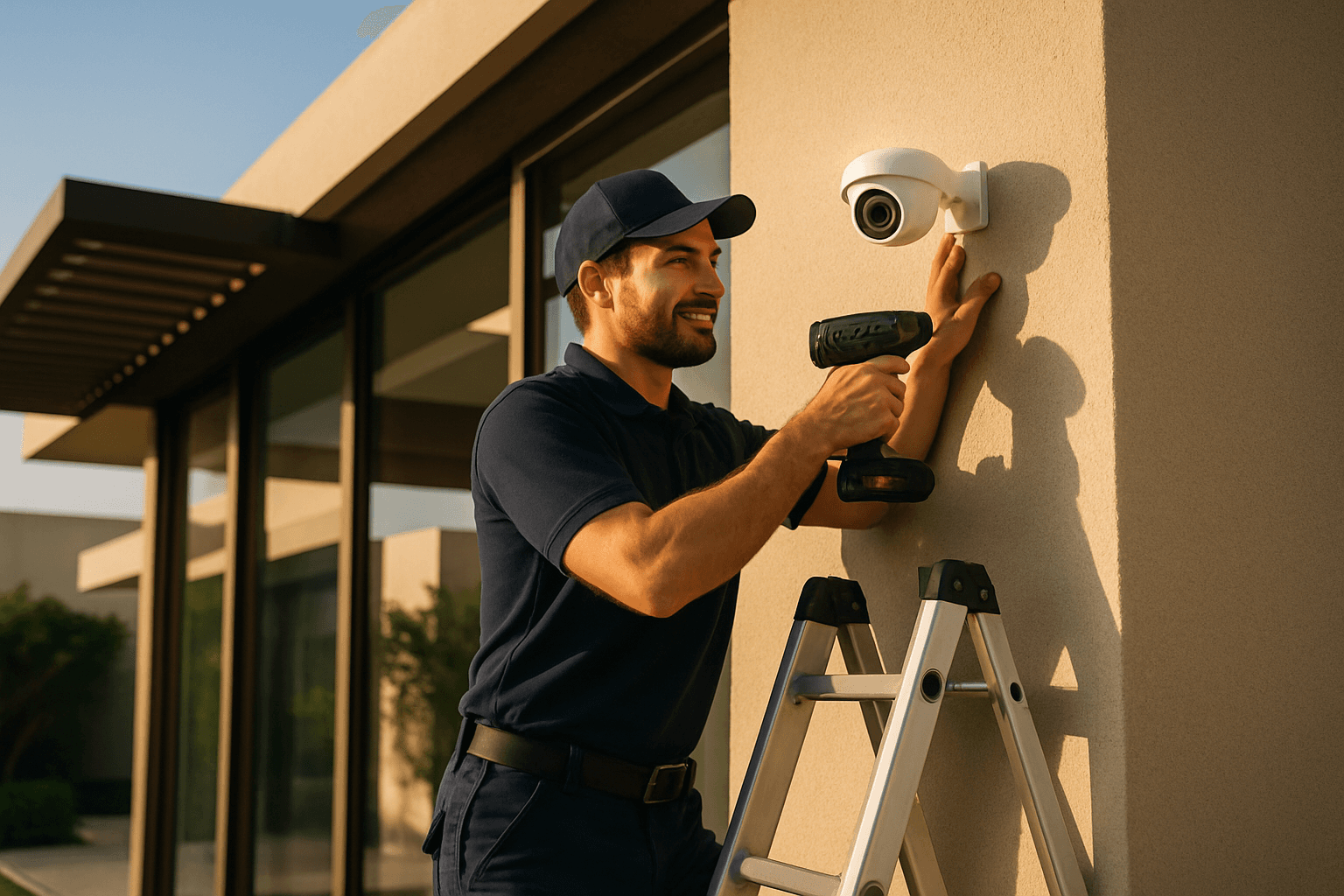
A camera on the wall means nothing if the footage is grainy, the storage is illegal, or the "company" that fitted it disappears the day something goes wrong.
And in Dubai, that last part matters more than anywhere else. Because the wrong installer doesn't just cost you money. It can cost you a SIRA fine, a blocked trade-licence renewal, or a court case if a camera is pointed at the wrong balcony.
So this guide isn't a list of ten random logos with fake five-star badges. It's the exact checklist to find, verify, and hire a genuinely SIRA-approved CCTV and security company in Dubai and across the Emirates, with honest 2026 AED prices, the SIRA rules explained in plain English, and the red flags that separate a real installer from a man with a drill and a website.
Read it once, and you'll never overpay or get caught out by a compliance surprise again.
The real problem: everyone in Dubai claims to be "SIRA approved"
Search "CCTV installation Dubai" and you'll see the same three words on every website: SIRA approved. Some of them are. Many are not, or the certificate expired two years ago, or the salesman is SIRA-carded but the company installing your system isn't licensed.
Here's why that gap is dangerous for you, not just for them:
- Commercial premises legally require a SIRA-approved installer. Offices, shops, warehouses, hotels, clinics and buildings with shared facilities must have their CCTV installed and certified by a SIRA-licensed company, then audited by SIRA before a trade licence is issued or renewed.
- Non-compliance carries fines of AED 5,000 to AED 50,000 and can block your trade-licence renewal entirely, freezing your business.
- Point a camera at a neighbour's garden, balcony or a shared corridor and you cross a privacy line. Under UAE law, recording private content without consent can trigger fines starting at AED 150,000 and, in serious cases, imprisonment.
So the single most valuable skill isn't picking a "best" brand. It's knowing how to verify the company before a single cable is run. Let's do exactly that.
What SIRA approval actually is (and when you legally need it)
SIRA is the Security Industry Regulatory Agency, Dubai's official body that licenses and audits every security system and security professional in the emirate. When a company is "SIRA approved," it holds a current licence to design, install and certify CCTV to Dubai's standards.
When you legally need a SIRA-approved installer:
- Commercial & mixed-use: Mandatory. No SIRA-certified CCTV, no trade licence. Full stop.
- Buildings with shared facilities (apartment towers, communities): Mandatory at entry and exit points.
- Standalone private villas: Not always legally mandated, but strongly advised. Even here, your system must respect privacy law and, if you ever need footage for a police case or an insurance claim, a properly installed and dated recording is what makes it usable.
If you want the deeper cost-and-compliance breakdown, read our companion guide on CCTV installation in Dubai: cost, SIRA rules, and choosing a company. This article stays focused on how to find and verify the right installer.
The 2026 SIRA rules in one glance
- Camera quality: Minimum 4MP (Ultra HD) for general zones; 8MP recommended for entrances, cash counters and high-detail areas.
- Footage retention: 31 days minimum for most businesses (retail, offices, warehouses, hotels); 90 days for banks, jewellers, healthcare and high-security premises.
- VideoGuard integration: Most commercial buildings must connect their recorder to VideoGuard, SIRA's monitoring portal, so inspectors can verify compliance remotely and authorities can access footage in an emergency.
- Installer: The installation must be carried out by a SIRA-licensed company, then audited and issued a SIRA NOC.
How to verify a CCTV company is actually SIRA approved
Do these four checks before you pay a deposit. They take ten minutes and they save you thousands.
- Ask for the SIRA company licence number and the licence's validity date, in writing. A real company sends it without hesitation. Hesitation is your answer.
- Cross-check it against SIRA's official directory. SIRA maintains a register of approved companies, accessible via their website or customer support. If they're not on it, walk away.
- Confirm the installing company is licensed, not just the salesperson. Some individuals hold a SIRA security card while the business behind them isn't licensed to certify systems. You need the company approval.
- Get the compliance promise on the quote. The written quote should state SIRA-compliant cameras, correct retention days for your property type, and VideoGuard integration where required. If it's vague, the system will be too.
Honest 2026 CCTV prices in Dubai (typical AED ranges)
Prices below are realistic 2026 market ranges across Dubai and the UAE. They move with camera brand, resolution, cabling distance and your building. Treat them as a sanity check, not a fixed quote, and always get the system priced against your actual site.
Two honest warnings. First, a headline "AED 1,400 for 4 cameras" deal is usually 2MP analogue, which will not pass SIRA's 4MP commercial standard, so a business buying it pays twice. Second, the cheapest quote almost always skips proper cabling and weatherproofing, and you find out during the first summer sandstorm.
How to choose the best CCTV company in Dubai: the checklist
A genuinely good installer ticks all of these:
- Current, verifiable SIRA company licence (checked against the directory, not just claimed).
- Free on-site survey before quoting. Anyone who prices your villa or shop over the phone without seeing it is guessing.
- A written, itemised quote listing camera model, resolution, number of cameras, recorder, storage capacity, retention days, and whether VideoGuard is included.
- Clean, concealed cabling and a tidy finish, with a next-day check that everything records.
- Mobile viewing set up and tested before they leave.
- A named warranty and a clear AMC option so support doesn't vanish after payment.
- Privacy-aware placement that covers your property without pointing into a neighbour's home or a shared space.
Red flags that should end the conversation
- They "can't find" or won't send the SIRA licence number.
- Prices quoted before any site visit.
- A quote with no camera resolution or retention days written on it.
- Pressure to pay the full amount up front, in cash, today.
- No physical business address, no warranty, no maintenance offer.
- Selling 2MP analogue as "SIRA compliant" for a commercial site (it isn't).
The honest shortlist: verified RightPro installers on TaskRight
Here's the uncomfortable truth about most "Best CCTV companies in Dubai" lists: they're paid placements, or invented names with invented ratings. We won't do that to you.
Instead, TaskRight gives you the shortlist the honest way. Every security and smart-home installer on the platform is a verified RightPro, a badge that's earned through verification, not bought. You describe the job once, and get matched with verified installers who compete for your work.
What makes this different from ringing three numbers off Google:
- Free quotes. You compare real prices side by side, so you see the fair market rate instead of one inflated number.
- 0% commission. The installer keeps 100% of what you pay. No platform cut is baked into your quote, which means no hidden markup passed to you.
- Verified, not random. RightPro status means the provider has been checked, not just the loudest advertiser on the results page.
- You hire direct. You talk to the installer, agree the scope, and hire the one you trust. No middleman between you and the person on your wall.
Every day you leave your home or business under a cheap, non-compliant, or non-existent camera is a day you're gambling with a break-in, a SIRA fine, or footage that's useless when you finally need it. That's a bad bet.
Take two minutes and get free quotes from verified smart home & security installers in Dubai, then compare and choose the RightPro that fits your property and budget.
👉 Find verified CCTV installers in Dubai →
Frequently asked questions
How much does CCTV installation cost in Dubai?
A basic 4-camera home system typically runs AED 1,400 to 2,500, a 4K SIRA-grade 4-camera system AED 3,500 to 7,000, and larger commercial systems AED 5,000 to 15,000+. Labour is around AED 80 per indoor camera and AED 100 per outdoor camera. Always price against your actual site.
How much does a single CCTV camera cost in Dubai?
Around AED 180 to 500 for an indoor camera and AED 450 to 1,200 for an outdoor or 4K night-vision camera, before labour. Popular brands like Hikvision and Dahua sit across this whole range depending on resolution.
Is SIRA approval mandatory for CCTV in Dubai?
Yes for commercial and shared-facility properties. Offices, shops, warehouses, hotels, clinics and apartment buildings must have CCTV installed and certified by a SIRA-approved company and audited by SIRA. Standalone private villas are not always legally required to, but it's strongly advised.
Do villas and homes need SIRA-approved CCTV?
A standalone private villa usually isn't legally forced to install SIRA-certified CCTV, but using a SIRA-approved installer is still the safe choice for quality, correct placement, and footage that's admissible for police or insurance. Communities and buildings with shared areas do fall under the mandatory rules.
How do I check if a CCTV company is SIRA approved?
Ask for their SIRA company licence number and validity date in writing, then cross-check it against SIRA's official directory (via their website or support). Confirm the installing company is licensed, not just an individual salesperson holding a SIRA card.
What are the SIRA CCTV requirements in 2026?
Minimum 4MP (Ultra HD) cameras for general zones and 8MP for high-detail areas; footage retention of at least 31 days for most businesses and 90 days for banks, jewellers and high-security sites; and VideoGuard integration for most commercial buildings, plus installation by a SIRA-licensed company.
What are the penalties for non-compliant CCTV in Dubai?
Fines typically range from AED 5,000 to AED 50,000 and can block your trade-licence renewal. Recording private content without consent, such as filming a neighbour's home, can trigger far heavier penalties, starting at AED 150,000 and potentially imprisonment.
Can I install CCTV myself in Dubai?
For a private villa you can install basic cameras yourself, but for any commercial or shared-facility property the system must be installed and certified by a SIRA-licensed company to be legal. DIY on a commercial site will fail the SIRA audit.
Is it worth installing CCTV at home?
Yes. It deters intruders, lets you monitor your property remotely, and provides dated evidence for police or insurance if something happens. For a modest one-time cost, it's one of the highest-value security upgrades a UAE home can make.
How long must CCTV footage be stored in Dubai?
Commercially, at least 31 days for most businesses and 90 days for high-security premises like banks and jewellers. There's no fixed legal minimum for private homes, but two to four weeks of storage is a sensible baseline.
Does my CCTV need to respect neighbours' privacy?
Yes. Cameras must focus only on your own property. The moment a camera captures a neighbour's balcony, garden or a shared corridor, you risk a formal complaint and serious legal consequences, so placement matters as much as the camera itself.
What is VideoGuard?
VideoGuard is SIRA's telemetry portal that most commercial buildings must connect their recorder to. It lets SIRA verify compliance remotely, gives authorities fast access to footage during investigations, and flags cameras that go offline.
What is the best CCTV brand in Dubai?
Hikvision and Dahua dominate for reliability and value, with Axis for advanced network setups and brands like Ezviz, IMOU and Ring for simpler smart-home needs. The "best" brand is the one matched correctly to your property and to SIRA's resolution rules, which is exactly what a verified installer will spec for you.
How long does CCTV installation take?
A typical home system is often installed in a single day, and many companies complete residential jobs within 24 hours of survey. Larger commercial systems with VideoGuard integration and a SIRA audit take longer, usually a few working days.