

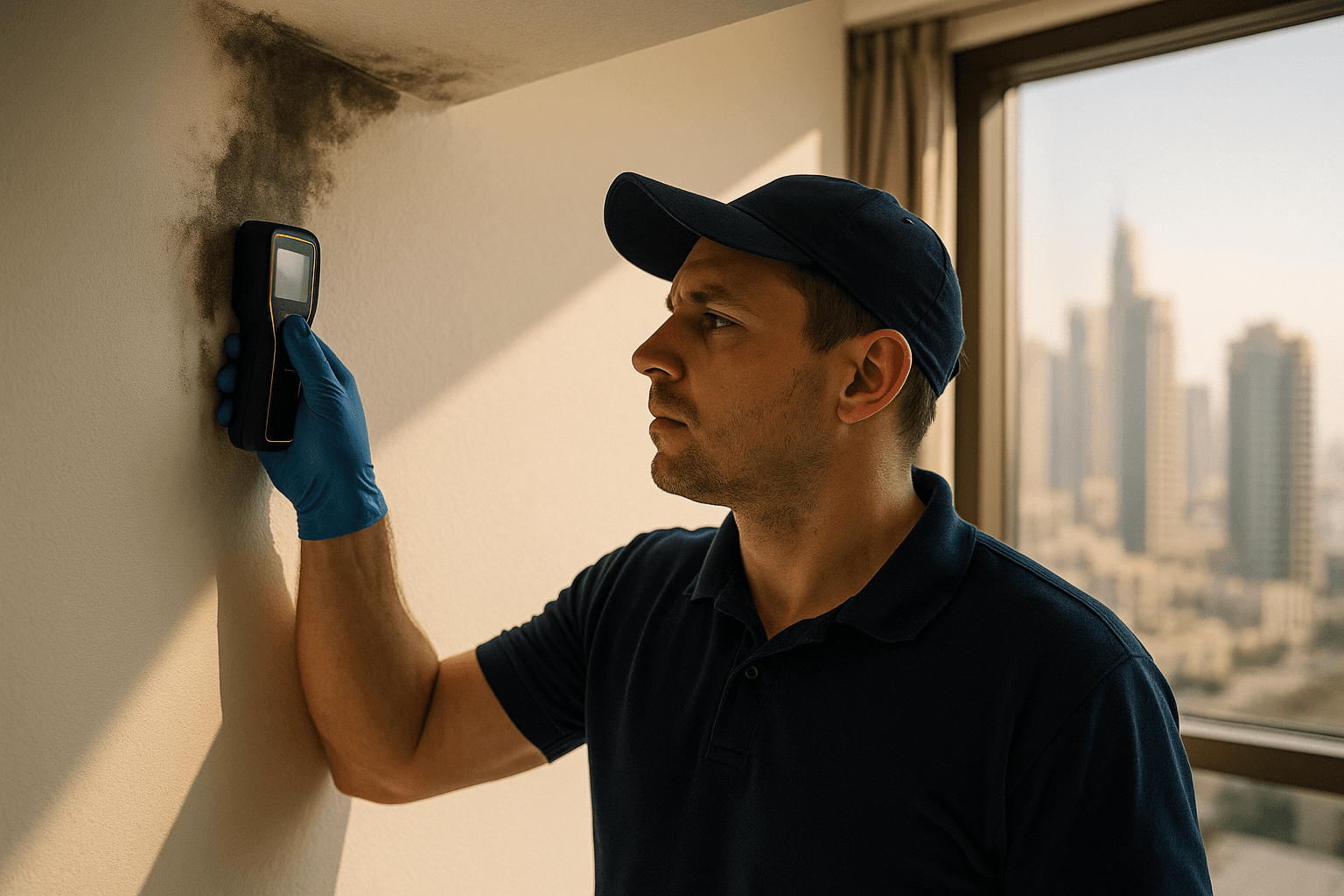
Mould removal in Dubai starts from AED 350 for a bathroom treatment, quoted after a free inspection. Whether you need a professional is the bigger question: the US EPA treats a patch under about 10 square feet, roughly three feet by three feet, as a job a homeowner can handle, and anything larger as remediation.
Then it comes back. You scrubbed the ceiling corner in March, repainted it in April, and by September the same grey bloom is spreading from the same spot. Every company you call sells you the scrub again. Almost none of them will say the thing that actually decides whether your money works: mould is not the problem, it is the receipt for a water problem nobody has found yet.
This guide uses the two authorities that publish their reasoning openly, the US Environmental Protection Agency and the World Health Organization, to answer the questions the Dubai mould-removal market leaves out, including the one where the honest answer is that you do not need to hire anyone.
How much does mould removal cost in Dubai?
Mould removal in Dubai starts from AED 350 for a single bathroom treatment. AED 350 is the entry figure on a Dubai mould price list published openly rather than held back for a phone call, and the figure covers removal, an antimicrobial treatment and sealing on one bathroom.
The honest caveat matters more than the number. A mould price is set by how much surface is affected and by what is wetting it, and neither is knowable over the phone. A company that quotes you a firm price for a Dubai villa before anyone has looked at the wall is pricing a guess, and the guess is usually corrected upwards on the day.
A separate cost sits underneath all of this and rarely appears on the quote: fixing whatever is putting water on the wall. Where a leaking chilled-water pipe or failed waterproofing is feeding the patch, the remediation is the cheap half of the job.
Why does mould keep coming back on Dubai walls?
Mould keeps coming back on Dubai walls because the moisture feeding it was never removed. The EPA is blunt about the mechanism: clean up the mould without fixing the water problem and, most likely, the mould problem comes back. Every recurring patch in a Dubai apartment is that sentence playing out.
What makes Dubai specific is where that water comes from. In a climate where the air outside is warm and wet and the surfaces inside are chilled hard for nine months of the year, the water does not need a leak. Condensation on a cold surface is enough, and the EPA lists condensation on windows, walls or pipes as a sign of high humidity to act on quickly.
Five places account for most recurring mould in Dubai homes, each with its own usual source.
The EPA names the fixes for three of those five directly: keep air conditioning drip pans clean and drain lines unobstructed, cover cold surfaces such as cold water pipes with insulation, and run the bathroom fan or open the window when showering.
What indoor humidity level causes mould in a Dubai home?
Sixty percent relative humidity is the line. The EPA advises keeping indoor humidity below 60 percent and ideally between 30 and 50 percent. Dubai sets the same ceiling in its own building code: the Dubai Green Building System requires air conditioning to hold indoor humidity between 30 and 60 percent for 95 percent of the year.
Now put Dubai's actual air beside that ceiling. The Dubai Government Media Office puts the emirate's annual average humidity at 59 percent, peaking at 65 percent in January and February. The outdoor air sits at the limit the code sets for indoors, and spends part of the winter above it.
The same building code covers the sweating-pipe case directly, requiring that pipes carrying chilled water and ducts supplying conditioned air be insulated to prevent condensation, to British Standard BS 5422 or another standard approved by Dubai Municipality. A chilled pipe sweating inside a wall cavity is a code failure rather than bad luck, which matters when you are deciding who should pay to open the wall.
How do you know whether a Dubai mould patch needs a professional?
The EPA publishes a threshold that decides it: about 10 square feet, which is roughly a three-foot by three-foot patch. Under that, in most cases a homeowner can handle the cleanup themselves. Over it, or where there has been a lot of water damage, the EPA points you to professional remediation guidance instead.
No Dubai mould-removal page we checked publishes that line, which is unsurprising, because the 10-square-foot line is the sentence that tells a share of their callers to hang up. The same line is also the single most useful fact a Dubai homeowner with a small bathroom patch can have.
- The mould covers more than about 10 square feet.
- There has been a lot of water damage.
- You suspect the air-conditioning system is contaminated, in which case the EPA says do not run it, because it could spread mould through the building.
- The water involved was sewage or other contaminated water.
Size is not the only trigger, and the third item on that list is the one Dubai homes hit most often. An AC system pushing spores around a sealed, air-conditioned apartment turns a local problem into a whole-home one.
Does mould on walls actually harm your health?
The World Health Organization reviewed the evidence in its 2009 indoor air quality guidelines on dampness and mould and concluded that the most important effects are increased prevalences of respiratory symptoms, allergies and asthma, as well as perturbation of the immunological system.
The WHO conclusion that matters for how you spend money is the next one: the most important means of avoiding those effects is preventing or minimising persistent dampness and microbial growth on interior surfaces and in building structures. Prevention, not removal, is what the guidance is built around.
The EPA adds a detail that changes what you should accept as finished work. Dead mould can still cause allergic reactions, so killing mould is not enough, it must also be removed. A treatment that sterilises a patch and leaves it in place has not finished the job.
What actually removes mould from a wall, and what only hides it?
Removing mould from a wall means physically taking it off a hard surface with detergent and water and drying the surface completely, which is what the EPA describes. Hiding it means anything that changes the colour of the patch without changing the moisture underneath it.
Two approaches produce very different outcomes on the same Dubai wall.
Two EPA points cut through most of the marketing here. Chlorine bleach is not recommended as a routine practice during mould cleanup. And absorbent or porous materials such as ceiling tiles and carpet may have to be thrown away, because mould grows into the spaces in them and can be impossible to remove.
Can you paint over mould in a Dubai apartment?
Painting over mould in a Dubai apartment fails, and the EPA says so in one line: do not paint or caulk mouldy surfaces, clean up the mould and dry the surfaces before painting, because paint applied over mouldy surfaces is likely to peel.
The treat-dry-paint ordering is the whole reason a mould job and a painting job get confused in Dubai. The visible repair really is a repaint, and a repaint really is what you want at the end. The sequence is treat, dry, then paint, and a contractor who starts at the paint is selling you the last step of someone else's job.
A Dubai handover or move-out inspection makes this expensive in a specific way. A repaint over a live damp patch will lift before the next tenancy ends, and the deduction lands on whoever signed for the work. Our guide to move-out painting costs in Dubai covers how those deductions get priced.
Where the damp is coming through from outside rather than condensing on the inside, the fix sits in the building envelope instead, which is a different trade again and is covered in our Dubai roof waterproofing guide.
Should you pay for a mould inspection or a mould test in Dubai?
An inspection is worth having and a laboratory test usually is not. The EPA position is that in most cases, if visible mould growth is present, sampling is unnecessary, because you already know what you need to know: there is mould, and there is water.
An inspection does something different and more useful. An inspection finds the moisture, which is the part you cannot see, and the moisture is the only basis on which a Dubai company can give you a fixed price rather than a range. At least one Dubai specialist publishes free inspection followed by a fixed written quote as its standard model, so paying for that step is optional.
The EPA does allow one narrow use for sampling: surface sampling may be useful to determine whether an area has been adequately cleaned after the work. Post-clean surface sampling is a check on the contractor, not a diagnosis, and is the only version of mould testing worth buying in Dubai.
Who pays for mould in a Dubai rental?
The legal default puts it on the landlord. Article 16 of Dubai Law No. 26 of 2007 makes the landlord responsible, during the term of the lease, for maintenance works and for repairing any defect or damage that affects the tenant's intended use of the property. Mould fed by a failed pipe or failed waterproofing sits inside that wording.
The EPA's own advice to renters is procedural and worth following in Dubai too: report all plumbing leaks and moisture problems immediately to the building owner, manager or superintendent. A dated report is what turns a dispute about a stained wall into a dispute with a paper trail.
How Dubai tenancy law splits maintenance responsibility between landlord and tenant, and what your contract can and cannot change, is covered in full in our guide to who pays for maintenance in a Dubai rental.
How do you get a mould removal quote in Dubai without paying a commission?
Get the inspection first, insist the quote names the moisture source and not just the cleaning, and compare companies on whether they will put the source fix in writing. A quote that prices only the visible patch is quoting half the job, and the half it leaves out is the half that decides whether you pay again next September.
Mould season in Dubai is not evenly spread either. Search demand for mould removal in the UAE runs highest in September and October, as the humidity of the long summer finally shows up on the walls, which is also when the good companies are busiest.
TaskRight is a verified, zero-commission home services platform in the UAE. Describe the damp patch once and RightPro-verified damp and painting specialists come back to you directly. Nobody takes a cut of their work, so nothing gets added to your price, and you deal with the company that will actually stand behind the repair.
👉 Get damp & mould quotes in Dubai →
You can also browse painting and decorating specialists on TaskRight if you would rather look before you describe the job.
Frequently asked questions about mould removal in Dubai
How much does mould removal cost in Dubai?
Mould removal in Dubai starts from AED 350 for a single bathroom treatment on the price list one Dubai specialist publishes openly. What you actually pay depends on how much surface is affected and whether the moisture source needs fixing too, so treat any figure quoted before an inspection as a guess rather than a quote.
How do I know if mould in my Dubai apartment needs a professional?
The US EPA puts the line at about 10 square feet, roughly a three-foot by three-foot patch. Below that, a Dubai homeowner can usually clean it themselves. Above it, or where there has been significant water damage, the EPA directs you to professional remediation guidelines rather than a scrub and a repaint.
Why does mould keep coming back on my Dubai walls?
Mould returns because the water did. The EPA states that if you clean up the mould but do not fix the water problem, the mould problem will most likely come back. In Dubai homes that water is usually condensation on cold surfaces, a blocked air-conditioning drain, or an uninsulated chilled pipe.
Can I just paint over mould in Dubai?
Painting over mould is the one shortcut the EPA names and rejects: do not paint or caulk mouldy surfaces, clean the mould and dry the surface first, because paint applied over a mouldy surface is likely to peel. A Dubai repaint over live mould buys a few months and loses the cost of the paint.
Is bleach the right thing to use on mould?
Chlorine bleach is not recommended as a routine part of mould cleanup, according to the EPA, which treats biocides as a professional judgement call rather than a default. The EPA also notes that dead mould can still cause allergic reactions, so killing mould on a Dubai wall is not the same as removing it.
Does mould on walls actually harm your health?
The World Health Organization's 2009 indoor air quality guidelines on dampness and mould concluded that the most important effects are increased prevalences of respiratory symptoms, allergies and asthma, plus perturbation of the immunological system. The WHO findings are why a Dubai damp patch is worth acting on early rather than living with.
What humidity level causes mould in a Dubai home?
The US EPA advises keeping indoor relative humidity below 60 percent, ideally between 30 and 50 percent. Dubai's own building code, the Dubai Green Building System, requires air conditioning to hold indoor humidity between 30 and 60 percent for 95 percent of the year, so 60 percent is the working ceiling in Dubai homes.
Is the landlord responsible for mould in a Dubai rental?
Article 16 of Dubai Law No. 26 of 2007 makes the landlord responsible for maintenance and for repairing any defect or damage affecting the tenant's intended use, unless the parties agree otherwise. Mould fed by a building defect falls under that default, but a Dubai tenancy contract can reassign it, so read the clause first.
Last updated: September 2026. Figures and guidance re-verified against the published sources named above on 15 September 2026.