

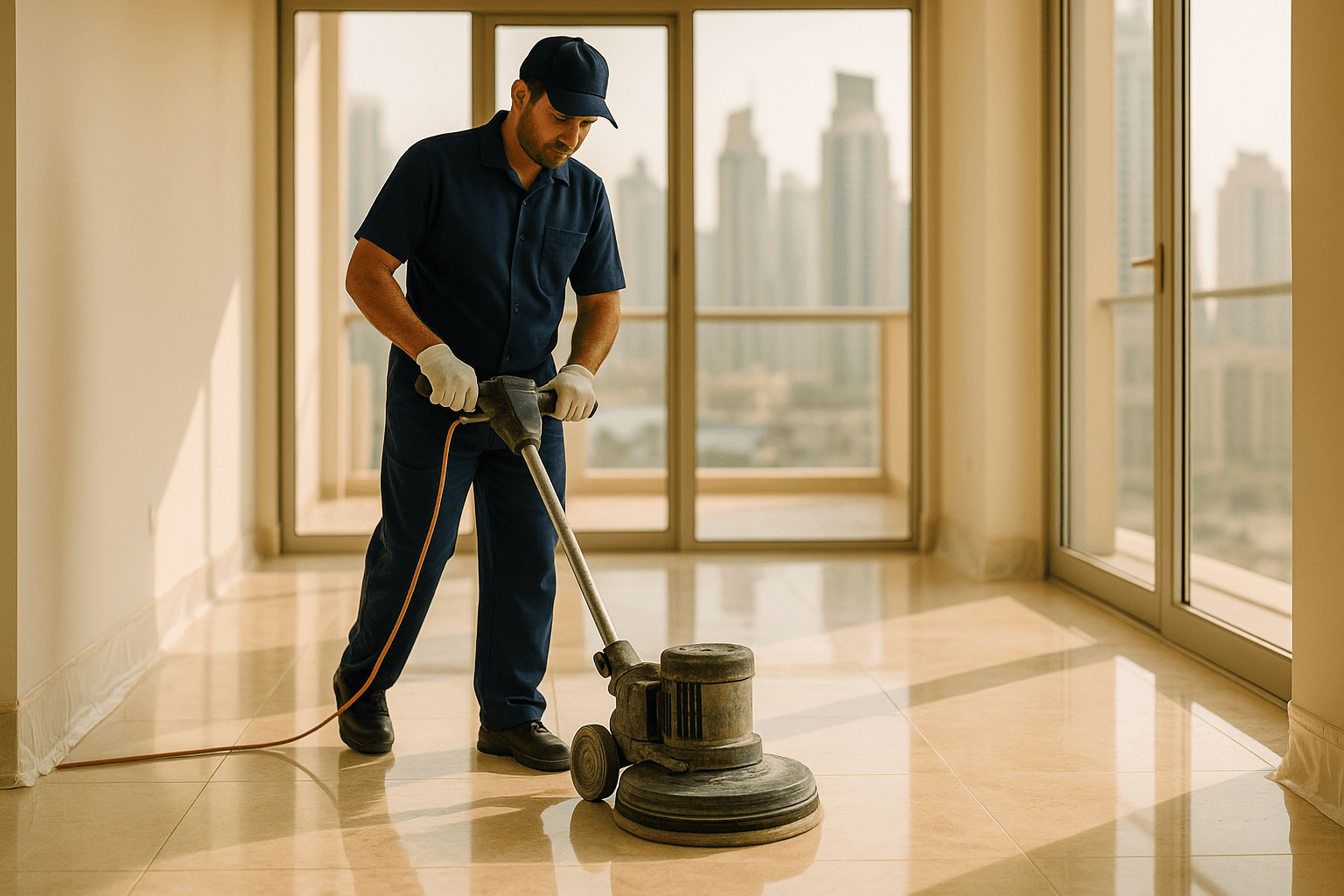
Marble polishing in Dubai is priced per square metre, and the rate depends on which of three jobs your floor needs: crystallisation, honing, or full grinding. One Dubai company, Primo, publishes marble polishing from AED 35 per square metre on its own service page. Scope, floor condition and access drive the rest of the price.
You noticed the dullness first in one strip of the living room, where the afternoon light crosses the floor. Then the hallway. Then the patch by the kitchen door where every visitor pivots. Marble never fails loudly. Marble wears down quietly, in a web of fine scratches from grit tracked in on shoes, from an acidic spray somebody used on a spill, from a sofa dragged an inch to the left. By the time the haze is visible from standing height, the stone has already lost the flatness that made it look deep and wet. Then the quotes arrive, so far apart that you wonder whether anybody is describing the same floor.
Three different jobs get sold in Dubai under the single word "polishing", and working out which one your floor actually needs is the decision that sets the price.
How much does marble polishing cost in Dubai?
Primo publishes marble polishing in Dubai from AED 35 per square metre on its own service page. Marble polishing in Dubai is quoted per square metre of floor area. The per-metre rate is set by which process the floor genuinely needs, and crystallisation, honing and grinding are not interchangeable pieces of work.
Two apartments on the same floor of the same Business Bay tower can carry very different rates, because one floor needs a chemical shine brought back and the other needs the stone cut flat again. Each company is pricing a different job.
What moves a marble polishing rate in Dubai:
- Process depth — crystallisation, honing and polishing, or full grinding.
- Floor condition — light haze versus deep scratching, acid etching, or tile edges standing proud of each other.
- Area and layout — one open living room polishes faster per metre than the same area split into bedrooms, corridors and cupboard recesses.
- Edges, stairs and skirting — hand work around perimeters and steps runs slower than open floor and is often priced as its own line.
- Occupied or empty — furniture moving, dust containment and evening working hours all add labour.
- Access — service lift bookings, parking for a heavy machine, water and power on the floor.
- Sealing — an impregnating sealer after the polish is a separate line, not an automatic inclusion.
Ask which process the rate covers before comparing anything at all.
What is the difference between grinding, honing and polishing marble in Dubai?
Grinding, honing and crystallisation are three distinct operations, and a Dubai quote for one is not a quote for another. Grinding cuts the stone flat with coarse diamond abrasives. Honing and polishing refine the cut surface through progressively finer abrasive steps until the shine comes out of the marble itself. Crystallisation buffs a chemical into the top layer to harden and brighten a floor without cutting it.
The table below sets out what happens to the stone in each process and when a Dubai floor actually calls for it.
Crystallisation applied over a scratched floor produces a shiny scratched floor. Grinding a sound floor that has only lost its gloss removes stone nobody needed to remove, and brings the mess of a heavy job with it. Matching the process to the damage decides whether the money was well spent.
How often should marble floors be polished in Dubai?
Marble floors in Dubai lose their finish on a schedule set by traffic and grit, not by the calendar. Fine sand carried in on shoes works as an abrasive under every footstep, so a villa in Arabian Ranches with a garden door dulls faster than a high-floor unit in Dubai Marina reached through a carpeted lift lobby.
Rather than booking a re-polish on a fixed cycle, watch the floor for the signals that answer it for you:
- Reflections in the walking lanes look softer than reflections near the walls.
- A haze appears across the floor when low sun rakes over it, even straight after cleaning.
- Water sits and darkens the stone instead of beading, pointing to a sealer that has worn through.
- Dull rings or pale patches mark where drinks, sprays or acidic products were left standing.
A floor usually needs maintenance long before it needs machinery. Grit mats at every entrance, a pH-neutral cleaner instead of acidic bathroom products, and felt pads under furniture legs push the next polish further away. A routine deep clean that lifts grit out of corners and grout lines protects the finish between visits.
Can dull or scratched marble be restored in Dubai?
Dull and scratched marble in Dubai can usually be restored, because polishing removes a thin layer of stone and exposes fresh material underneath rather than painting over the damage. Surface scratches, worn traffic lanes, acid etching from cleaning products and light staining all sit within reach of an abrasive process.
Limits exist, and an honest contractor names them before the machine comes out of the van:
- Cracks and chips need filling and repair as separate work — abrasives alone do not close them.
- Deep stains that soaked into the stone may need poulticing, and some never lift completely.
- Loose or hollow tiles have to be re-fixed first, because a heavy machine over a hollow tile makes the problem worse.
- Previously coated floors carry a wax or acrylic film that has to be stripped before anybody can read the stone underneath.
Ask for a test patch in a discreet corner before committing the whole floor. Finished stone in your own apartment, under your own lighting, settles it far faster than photographs of somebody else's project.
How do you protect an occupied Dubai apartment during marble polishing?
Marble polishing inside an occupied Dubai apartment is a wet, messy trade, and protection is the part of the scope homeowners forget to ask about. Wet systems run water through the machine to cool the abrasives and hold the dust down, producing a grey slurry that has to be vacuumed up and carried out. Dry systems avoid the slurry but demand serious extraction to keep stone powder out of wardrobes, air conditioning returns and soft furnishings.
Get the protection plan in writing before work starts:
- Masking of skirting, door frames, kitchen kickboards and wardrobe bases, all of which sit directly in the machine's path.
- Sheeting and taped zip doors on rooms staying in use, so a JVC two-bedroom stays livable while one room is worked.
- A stated route for slurry water, and a rule that slurry never goes into a bathroom drain unfiltered.
- Protection for the service lift and corridor, plus whatever approval your building management asks for before machinery comes up.
- Agreed working hours, and a final clean that includes the dust settled on high surfaces and inside cupboards.
What should a marble polishing quote in Dubai include?
A marble polishing quote in Dubai only becomes comparable once it names the process, the measured area, the abrasive sequence and the finish level. Two numbers sitting side by side mean nothing until both describe the same operation on the same floor.
A quote worth comparing names each of these lines explicitly.
How do you find a marble polishing company in Dubai you can trust?
Trust comes down to two things: quotes that describe identical work, and providers whose identity and trade licence somebody has actually checked. A number typed into a WhatsApp message by an unverified contact is not a quote.
TaskRight is a verified, zero-commission home services platform in the UAE, built so homeowners get real quotes from real companies with nobody clipping the job in the middle. Describe the floor once — area, condition, occupied or empty — and RightPro-verified providers come back with free quotes. You choose the company, you hire direct, and you pay the company direct.
Still shortlisting? Our guide to the best home cleaning companies in Dubai applies the same checks across the wider home care trade.
👉 Get free marble polishing quotes in Dubai →
Frequently asked questions about marble polishing in Dubai
Does marble polishing in Dubai remove deep scratches?
Marble polishing in Dubai removes scratches that sit within the surface layer, because diamond abrasives cut a thin layer of stone away and expose fresh material. Deep gouges, chips and cracks need repair work first, and a contractor should say so before quoting. Ask for a test patch on the worst area so the realistic result is visible before the whole floor starts.
Is crystallisation the same as polishing marble in Dubai?
Crystallisation and polishing are different services in Dubai. Crystallisation buffs a chemical into the top layer of marble to harden and brighten it, leaving any scratches underneath in place. Polishing uses diamond abrasives to cut and refine the stone itself, so the shine comes from the marble rather than from a treatment. Ask which process a marble polishing quote in Dubai covers.
Do marble floors in Dubai need sealing after polishing?
Sealing is worth doing on marble floors in Dubai after polishing, because a freshly cut surface is open and an impregnating sealer slows the rate at which spills soak in. Sealing is a separate line item rather than an automatic inclusion, so confirm in writing whether the quote covers it, which sealer is used, and how long the floor must stay dry.
Can marble polishing be done room by room in a Dubai apartment?
Marble polishing can be done room by room in a Dubai apartment. Sheeting and taped zip doors keep dust and slurry out of the rooms still in use while one area is worked. Phasing adds set-up time, so ask whether the marble polishing quote prices the floor as one visit or as several.
What makes marble floors in Dubai go dull?
Marble floors in Dubai go dull mainly from fine sand tracked in on shoes, which grinds against the surface under every footstep and leaves a web of shallow scratches. Acidic cleaning products, spilled juice and vinegar etch the stone chemically. Dragged furniture cuts deeper lines. Grit mats at entrances and pH-neutral cleaners slow the damage down.
Related reading:
Last updated: September 2026