


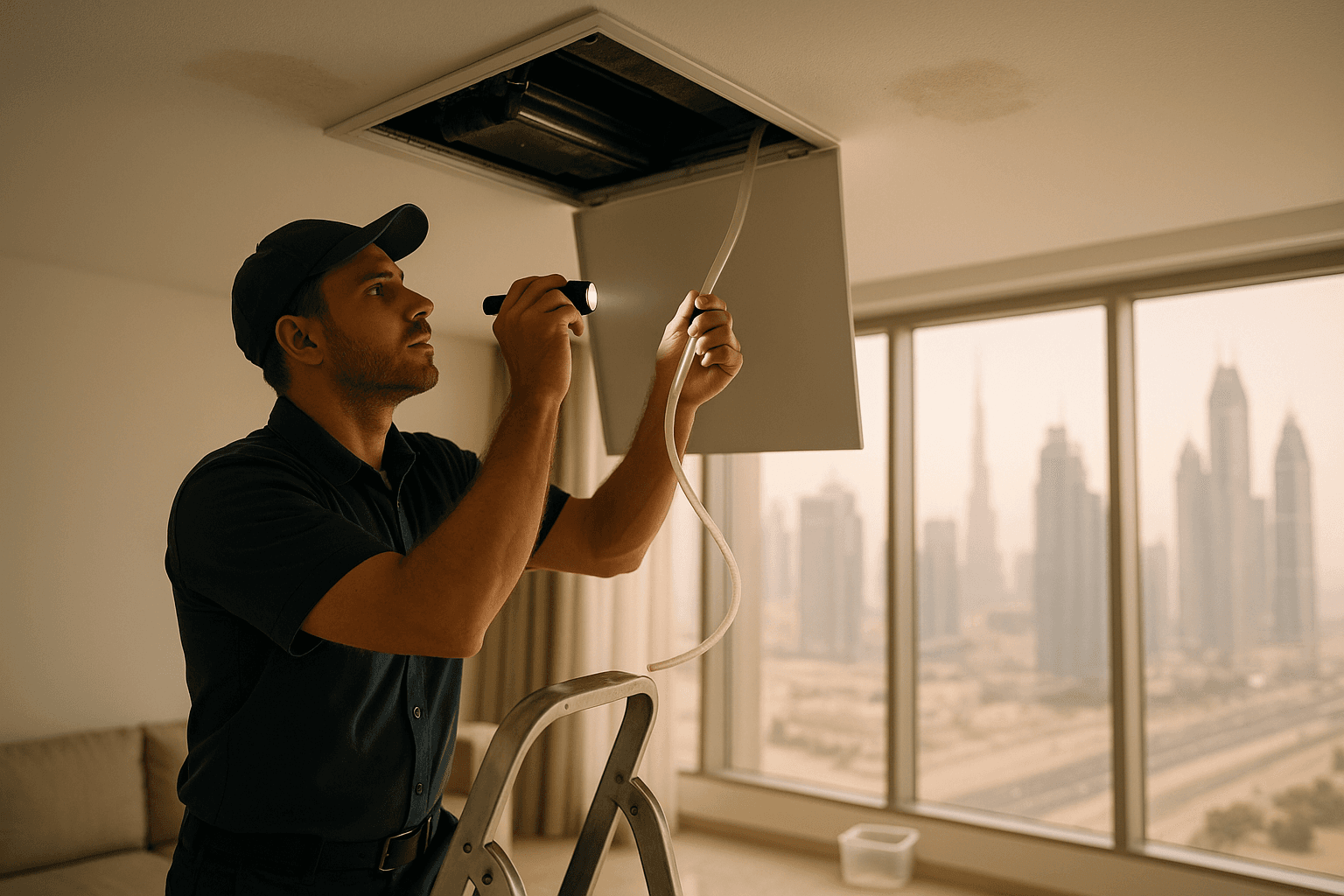
Water dripping from an AC in a Dubai home is almost always condensate that cannot drain away, not refrigerant. Dubai's Green Building System requires every air conditioner's collection pan and drain pipe to prevent stagnant water, with a 25 mm air break before the wastewater pipe. Blocked or dry, the pan overflows.
A ceiling stain is never where the problem is. By the time a brown ring shows up in your living room — or in the apartment below yours — water has been sitting in a ceiling void for days, soaking gypsum, insulation and whatever cable runs through it. Most homeowners call the first AC company that answers, pay for a coil clean, and watch the drip come back the following week. The wrong trade fixed the wrong thing, and nobody checked which side of a legal boundary the fault was sitting on.
Why is water dripping from my AC indoor unit in Dubai?
Water drips from an indoor AC unit in Dubai when condensate escapes the collection pan instead of leaving through the drain pipe. Every cooling coil makes that water: the coil runs colder than the dew point of the room air, moisture condenses on it, and gravity carries it into a pan underneath.
Dubai regulates the rest of that journey. Clause 601.02 of the Dubai Green Building System (Al Safat), Version 2.0 requires “condensate collection pans and drainage pipes… to provide proper drainage and to prevent any stagnant water”, a minimum air break of 25 mm between the condensate piping and the wastewater pipe, and discharge through a properly sized water trap. The clause binds all buildings including existing buildings.
Refrigerant does not drip. Refrigerant escapes as gas, and a refrigerant fault shows up as weak cooling or ice on the pipework — a different problem with a different fix. A technician who reaches for the gas gauge when the complaint is water is guessing, and topping up refrigerant every visit is its own red flag.
Which is the main reason for water leakage in an AC?
The main reason for water leakage in an AC is a condensate drain that has stopped carrying water away. Dust, biofilm and algae build up in a pan that never dries, migrate into the drain pipe, and close it. Everything upstream still works — which is why the unit keeps cooling while it floods.
Each row below pairs a fault with what you see in the room, and with the side of the ownership boundary the repair sits on. The final column decides who you are allowed to call.
Is it safe to run the AC while it is leaking water?
Running a leaking AC is safe only while the water is falling clear of anything electrical, and in a Dubai ceiling that is rarely true for long. Water tracks sideways along a slab or a duct before it drops, so the visible wet patch often sits several metres from the fault — and somewhere along that path are downlights, a smoke detector and cable trays.
Switch the unit off at its isolator, not just the remote, if any of these are true:
- Water is coming through or near a light fitting, ceiling speaker or smoke detector.
- The ceiling board is sagging, bulging or has gone dark and soft.
- Water is reaching a socket, a distribution board or an extension lead.
- The drip started with a smell of burning, or a tripped breaker.
Short of those, a Dubai summer makes switching off its own hazard, so keep the room habitable and get the drain cleared quickly rather than sit in the heat. Put a container under the drip, keep the floor dry, and stop running the unit overnight while nobody is watching it.
Do you have a split AC or a chilled-water fan coil unit — and why does it change everything?
Before anyone quotes you, settle which machine is in your ceiling. A Dubai villa or low-rise almost always has a split or ducted system with its own condenser outside. A tower on district cooling has no condenser at all: chilled water arrives from a central plant and a fan coil unit blows room air across it. Both make condensate. Only one is wholly yours.
The final row below is the one that changes who picks up the phone.
One misconception costs Dubai residents weeks. Executive Council Resolution No. (6) of 2021 defines the District Cooling Network as the pipelines carrying chilled water “from a District Cooling Plant… to one or more Buildings” — the regulated system stops at the building line, and Empower's own Conditions of Service put the building's chilled-water circuit on the building. The district cooling company does not fix your fan coil unit. What it bills you for is chiller and district cooling charges, a separate argument entirely.
Why does the water appear in the flat below and not in yours?
A concealed fan coil unit sits above a false ceiling, and a false ceiling is a tray, not a barrier. Condensate that misses the pan lands on the structural slab, runs to the lowest point it can find, and leaves through whatever penetrates that slab — a drain sleeve, a cable pass, a light box. Your neighbour sees a brown ring long before you see anything at all.
Dubai law is unusually precise about whose space that is. Article 9 of Law No. (6) of 2019 states that a Unit includes “plaster ceilings and all other types of ceilings… and spaces between such ceilings”. The void above your head belongs to your apartment. But the same article adds that a Unit does not include utility services running through it that serve the Common Parts or another Unit — so the pipe crossing your void on its way to somebody else's flat is not yours, even though the void is.
The distinction decides most neighbour disputes in Dubai towers. A leak from your own fan coil unit into the flat below is yours to fix. A leak from a shared line that merely passes through your ceiling is the building's — and paying to patch it quietly takes on a liability that was never yours.
Why do AC water leaks behave differently in Dubai than anywhere else?
Because the machine never gets a night off. The Dubai Government Media Office puts the city's summer average high at 41.8 °C with overnight lows around 29.7 °C, and annual average humidity at 59%, peaking at 65% in January and February. Air that warm and that wet is still being dehumidified at four in the morning.
Al Safat clause 402.01 sets the target the system has to hit: an HVAC installation must be capable of holding relative humidity between 30% and 60%, and dry bulb temperature between 22.5 °C and 25.5 °C, for 95% of the year. Every percentage point of humidity removed leaves the air as liquid water in a pan. A Dubai pan is wet around the clock for months — the precise “stagnant water” condition clause 601.02 exists to prevent, and the reason drains silt up here faster than newcomers expect.
A second Dubai-specific failure mode has no AC fault in it at all. Clause 502.11 requires all pipes carrying chilled water, and all ducts supplying conditioned air, to be insulated to British Standard BS 5422 “to prevent condensation”. Ceiling voids here are hot and humid. Strip, crush or soak that insulation and the pipe itself sweats, dripping steadily while the AC works perfectly.
Who owns the AC drainage in a Dubai tower — you or the building?
Two questions hide inside “who fixes it”, and mixing them up turns a small leak into a long argument. The first is ownership: whose equipment is it. The second is access: whose permission do you need to reach it. Dubai answers the first in law and leaves the second to your building. The table below maps each part of a Dubai cooling installation to the article of Law No. (6) of 2019 that governs it.
Do I need building permission to clear a concealed AC drain in Dubai?
Here the honest answer matters more than a confident one. No Dubai law says that only a developer-appointed contractor may open a ceiling and clear a condensate drain. What the law does say, at Article 39 of Law No. (6) of 2019, is that substantial alterations to any part of the jointly owned property require the approval of the master developer, the Dubai Land Department and the competent authority. Clearing your own drain is maintenance and needs none of that. Re-routing a condensate line into a shared stack is an alteration and needs all of it.
On top of the law sits your building's own rule book, and that is where the “approved contractor” requirement actually lives. An owners association or management company can require registration, insurance and a work permit before anyone reaches a common service. In Dubai Development Authority areas the maintenance permit is applied for by the contractor, not the resident, and the documents include a contractor appointment letter from the owner or tenant — so the firm you hire has to be one that can actually file it.
Ask any contractor two questions before they start: which side of that boundary the fault is on, and whether they are registered to work in your building. A firm that cannot answer either is about to open your ceiling and hope.
Can I fix an AC water leak myself, or do I need a technician in Dubai?
You can do the first ten minutes yourself. Beyond that, a concealed fan coil unit in a Dubai tower needs a technician with a wet vacuum, a pressure line to blow the drain through, and a way of getting the ceiling tile back without cracking it.
Tenants have a further constraint that has nothing to do with skill. Article 19 of Law No. (26) of 2007 says that, without prejudice to restorations customary for tenants to undertake, the tenant may not carry out maintenance works unless permitted by the landlord. Clearing a filter is customary. Commissioning a contractor to open a ceiling is not, and doing it unasked can put the cost on you.
Safe to do yourself, in any Dubai home:
- Photograph the drip, the stain and the ceiling around it, with a timestamp.
- Check and clean the indoor unit's filters — a blocked filter ices the coil and floods it.
- Put a container under the drip and keep the floor dry.
- Check whether water is coming out of the drain outlet outside at all.
- Message building management in writing the same day, even if you think it is your unit.
- Ask your neighbour below whether anything has appeared on their ceiling.
Anything that involves opening a ceiling, cutting a pipe or touching a shared line stops being maintenance. Hire someone who tells you which of those they are about to do before they do it, in writing.
Who pays for an AC water leak in a Dubai rental — the tenant or the landlord?
The landlord pays, by default. Article 16 of Law No. (26) of 2007 reads: “Unless otherwise agreed by the parties, the Landlord will… be responsible for the Real Property maintenance works and for repairing any defect or damage that may affect the Tenant's intended use.” Those opening words are why many Dubai tenancy contracts hand minor maintenance to the tenant up to a stated amount per incident — the general rule is set out in full in our guide to who pays for maintenance in a Dubai rental.
A condensate leak adds a question no tenancy clause answers: water damage travels. A blocked drain is a small repair. The soaked ceiling, the ruined flooring and the neighbour's claim from the flat below are not, and they are not what a maintenance threshold was written to cover.
The three checks that settle most Dubai AC leak disputes:
- Is the fault in the unit serving your flat, or in a shared line? Law No. (6) of 2019 decides that, and no tenancy clause overrides it.
- Did you report the leak in writing the day you saw it? Article 19 requires a tenant to look after the property as an ordinary person would, and delay is where liability starts.
- Is the claim for the repair, or for the damage the water caused? Separate the two before anyone quotes on either.
What to have ready before you call an AC technician in Dubai
A technician who arrives knowing which machine is in your ceiling does the job in one visit. One who arrives blind sells you a coil clean and comes back. Have these four answers ready.
- System type — split, ducted, or a chilled-water fan coil unit on district cooling.
- Where the water shows — the room, the height, and whether the flat below has anything on its ceiling.
- When it started — after a service, after a filter change, or on its own.
- Your status — owner or tenant, and whether your contract has a maintenance clause.
Then get more than one quote, and ask each to price the making-good of the ceiling separately — that is where a cheap quote quietly becomes an expensive one. Our Dubai AC repair price guide sets out what the common faults cost.
👉 Find verified AC technicians in Dubai →
Frequently asked questions about AC water leaks in Dubai
Why is my AC leaking water in Dubai?
An AC leaking water in Dubai is shedding condensate that cannot reach the drain. The coil pulls moisture out of your room air into a collection pan, which drains through a pipe and a trap. Block any of the three and the pan overflows.
Is it safe to run the AC while it is leaking water in Dubai?
Running a leaking AC in a Dubai home is safe only while the water falls clear of anything electrical. Switch it off at the isolator the moment water reaches a light fitting or a socket. Water travels sideways along a ceiling, so the wet patch rarely sits under the fault.
Which is the main reason for water leakage in an AC?
The main reason for water leakage in an AC is a condensate drain that no longer carries water away — a blocked pipe, a silted pan or a dry trap. Dubai's Green Building System clause 601.02 requires drainage that prevents the stagnant water breeding that blockage.
Who do I call for an AC water leak in a Dubai apartment?
Call your own AC contractor for an AC water leak in a Dubai apartment when the fault sits in the unit serving your flat. Call building management when the water comes from a shared chilled-water circuit or drainage stack, which Law No. 6 of 2019 makes a Common Part.
Who pays for an AC water leak in a Dubai rental — the tenant or the landlord?
The landlord pays for an AC water leak in a Dubai rental by default. Article 16 of Law No. 26 of 2007 makes the landlord responsible for maintenance and for repairing defects affecting the tenant's intended use — but it opens with “unless otherwise agreed by the parties”.
Can an AC water leak cause mould in a Dubai apartment?
An AC water leak can cause mould in a Dubai apartment because the water soaks gypsum and insulation inside a ceiling void that never dries out. Dubai's building code requires the air conditioning to hold relative humidity at 60% or below; a soaked void sits far above that.
Fix the leak once, by calling the right trade first
Most repeat AC leaks in Dubai are not hard repairs. They are the right repair done by the wrong party, on the wrong side of a boundary Law No. (6) of 2019 already drew. Work out whether the water comes from your own unit or a shared line, then hire accordingly.
TaskRight is a verified, zero-commission home services platform in the UAE — every AC technician on the platform is RightPro-verified, and you hire and pay them direct. Describe the leak once and let the technicians who actually work on your kind of system come to you.
Related reading:
Sources: Dubai Green Building System (Al Safat) v2.0, clauses 402.01, 502.11 and 601.02; Law No. (6) of 2019 Concerning Ownership of Jointly Owned Real Property; Law No. (26) of 2007 Regulating the Relationship between Landlords and Tenants; Executive Council Resolution No. (6) of 2021; Empower Conditions of Service; Dubai Government Media Office. Last updated: September 2026