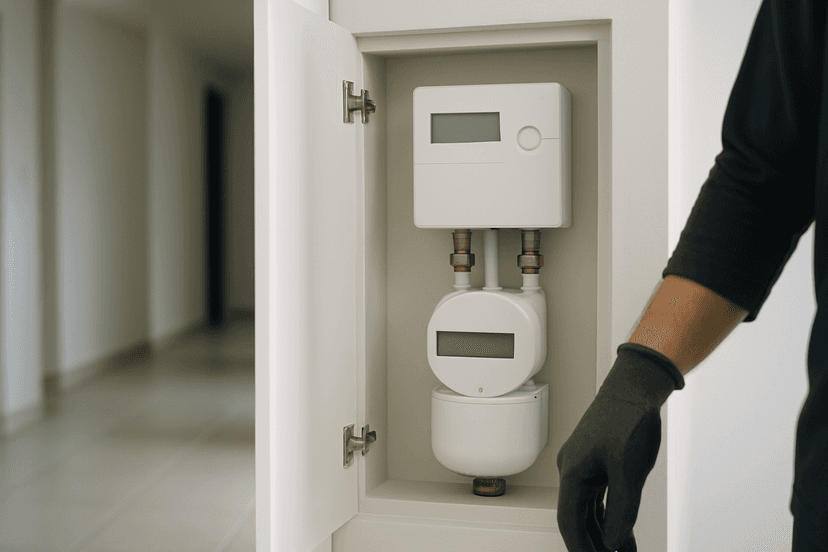


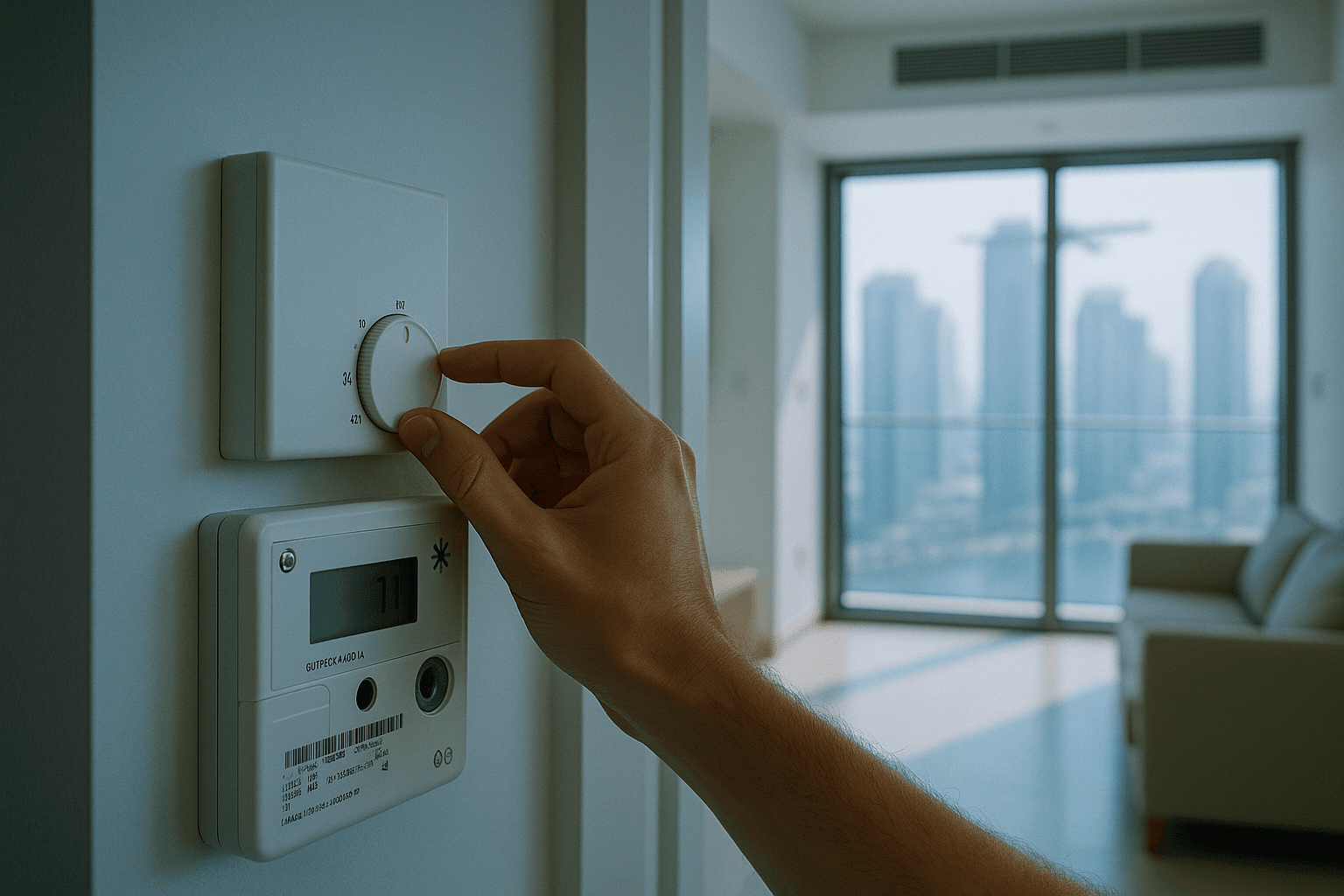
Dubai chiller fees have two parts: a capacity charge you pay every month regardless of use, and a consumption charge for the cooling you actually meter. On one provider's published residential rates, capacity is AED 750 per refrigeration ton per year and consumption is AED 0.62 per ton hour. A vacant flat still gets a bill.
Which is why the most common chiller complaint in Dubai is not "my bill is high" — it is "I was away all month and still got charged." You were not overbilled and nothing was broken. You were paying the charge that exists whether or not you ever turn the cooling on, and almost nobody explains that before you sign. One district cooling provider states it in its own FAQ in eight words, and those eight words are the whole story.
⚡ Quick Summary
- The capacity charge is payable "regardless of connection or consumption" — a provider's own words, not our interpretation.
- The security deposit is eight months of the capacity charge, which on a 4 TR flat is AED 2,000.
- You do not choose your contracted capacity. The building owner's consultant sets it and Dubai Municipality authorises it.
- Only the consumption half can be reduced by behaviour. The rest is fixed the day you move in.
What are chiller fees in Dubai?
Chiller fees are what you pay for district cooling — chilled water piped to your apartment from a central plant instead of a compressor bolted to your building. The table sets out every charge type a Dubai district cooling customer meets, in the words the providers use themselves.
Why do you pay a chiller bill when the AC is off?
Because the capacity charge is not a charge for cooling. It reserves plant capacity in your name, and one Dubai district cooling provider states in its own published FAQ that the contracted capacity charge is paid by the property owner or tenant each month "regardless of connection or consumption".
💡 Definition: a refrigeration ton, and why your flat has a number
A refrigeration ton (TR) is a unit of cooling power. Your apartment is contracted for a fixed number of TR — its capacity — and a ton hour (TRH or RTH) is one ton of cooling delivered for one hour, which is what the meter counts. Capacity is what the plant promises to be able to give you. Consumption is what you actually took. You are billed for both.
Travelling for a month, leaving a property empty between tenants, or simply never switching the cooling on does not reduce the capacity half of the bill by a single dirham. That is the design of the tariff, not a fault in it — and it is the single fact worth knowing before you sign a Dubai tenancy in a district-cooled tower.
How much are chiller fees in Dubai?
Rates differ by provider and by building, and most Dubai district cooling providers do not publish a residential rate card at all. The table below reproduces the residential rates published by one provider that does, so every figure is attributable rather than averaged.
A separate provider independently states the same eight-month deposit basis and adds a one-time activation fee of AED 200. The published page carrying the rates above notes that they are subject to change and that the charges finally agreed appear in your contract — so treat the contract, not any website, as the number that binds you.
⚠️ What we deliberately did not publish
Rates widely quoted online for Dubai's largest district cooling provider, including a consumption figure of AED 0.568 per ton hour, appear only on third-party blogs. That provider's own customer agreement was not reachable to us, so we have not printed its rates as fact. Read your own provider's tariff schedule and your signed contract — those are the only two documents that decide your bill.
How much is the chiller security deposit in Dubai?
The chiller security deposit is eight months of your capacity charge, and two Dubai district cooling providers state that basis independently. The arithmetic on a 4 TR apartment at the published residential rate is printed below so you can reproduce it for your own tonnage.
A 4 TR Dubai apartment therefore owes AED 275 a month before a single ton hour of cooling is metered. Consumption is charged on top at AED 0.62 per ton hour, so a month in which the meter records 800 ton hours adds AED 496 and produces a bill of AED 771. Substitute your own metered figure — the 800 is an illustration of the arithmetic, not a claim about typical usage.
Who decides your contracted capacity?
Not you, and not on move-in day. The contracted capacity for your apartment is set during the building's design, and one provider states that it is "approved by the building owner's consultant and authorized by Dubai Municipality". By the time a tenant signs a lease, the tonnage that drives the fixed half of the bill was fixed years earlier by somebody they will never meet.
Which is why two identically sized flats in different Dubai towers can carry noticeably different fixed charges. When you view an apartment, ask for the contracted TR and the provider's current tariff before you ask about the view. It is the one recurring cost in a Dubai home that you cannot renegotiate afterwards.
How can you cut a Dubai chiller bill?
✅ Only the metered half moves — here is what moves it
- Read the meter, not the bill. Ton hours are the only number you can change. Track them monthly and you can see what a habit costs.
- Fix the envelope before blaming the tariff. Gaps around doors, unsealed balcony frames and bare west-facing glass push ton hours up all summer.
- Service the in-home equipment. A district-cooled flat still has a fan coil unit and a filter. A clogged unit runs longer to reach the same temperature, and longer means more ton hours.
- Check for a faulty thermostat or valve. A valve that fails open meters cooling you never asked for, and the bill looks like overcharging.
- Budget the fixed floor honestly. Treat capacity, meter and deposit as rent, because they behave like rent.
The third and fourth items are the ones a homeowner can act on this week, and both are ordinary AC servicing jobs rather than anything a district cooling provider handles. TaskRight is a verified, zero-commission home services platform in the UAE — every provider is checked before they can quote you, and they keep 100% of what you pay them.
What is the difference between a chiller-free and a district-cooled apartment?
"Chiller free" in a Dubai listing means the landlord has absorbed the cooling charge, not that cooling is free to produce. The comparison below is what actually changes for you.
Frequently asked questions about chiller fees in Dubai
Why am I charged chiller fees when my apartment is empty?
Because the capacity charge reserves cooling capacity rather than paying for cooling used. One Dubai district cooling provider states in its own FAQ that the contracted capacity charge is paid each month regardless of connection or consumption. Only the metered consumption charge falls to zero when an apartment in Dubai sits empty.
How much is the district cooling security deposit in Dubai?
The district cooling security deposit in Dubai is eight months of your contracted capacity charge, stated independently by two providers. On a 4 TR apartment at a published rate of AED 750 per TR per year, the monthly capacity charge is AED 250, making the refundable deposit AED 2,000.
What is a refrigeration ton on a Dubai chiller bill?
A refrigeration ton (TR) is a unit of cooling power, and it sets your contracted capacity in Dubai. A ton hour (TRH) is one ton of cooling delivered for one hour and is what the meter counts. Capacity charges use TR, and consumption charges use TRH.
Can I reduce my contracted capacity in Dubai?
Not as a tenant. The contracted capacity is approved by the building owner's consultant and authorised by Dubai Municipality during the building's design, long before a lease is signed. Ask for the contracted TR figure while viewing a Dubai apartment, because it fixes the unavoidable half of your bill.
Does chiller free mean cooling costs nothing in Dubai?
No. Chiller free means the landlord pays the district cooling charges rather than passing them to you, so the cost is built into the rent instead. You avoid the separate bill and the eight-month capacity deposit, but you are still paying for the cooling somewhere in the contract.
What can actually lower my chiller consumption in Dubai?
Only the metered half responds to anything you do. Servicing the fan coil unit and its filter, sealing gaps around doors and balcony frames, shading west-facing glass, and replacing a thermostat or valve that has failed open all reduce the ton hours your Dubai meter records each month.
👉 Get your fan coil unit serviced in Dubai →
Method: the charge definitions, the eight-month deposit basis, the AED 200 activation fee and the wording on contracted capacity were read directly from Dubai district cooling providers' own published FAQ and pricing pages on 10 August 2026. Rates shown are one provider's published residential schedule and are stated as such; that page notes rates are subject to change and that agreed charges appear in your contract. Rates for providers whose own documents we could not open were left out. Last updated: August 2026.