


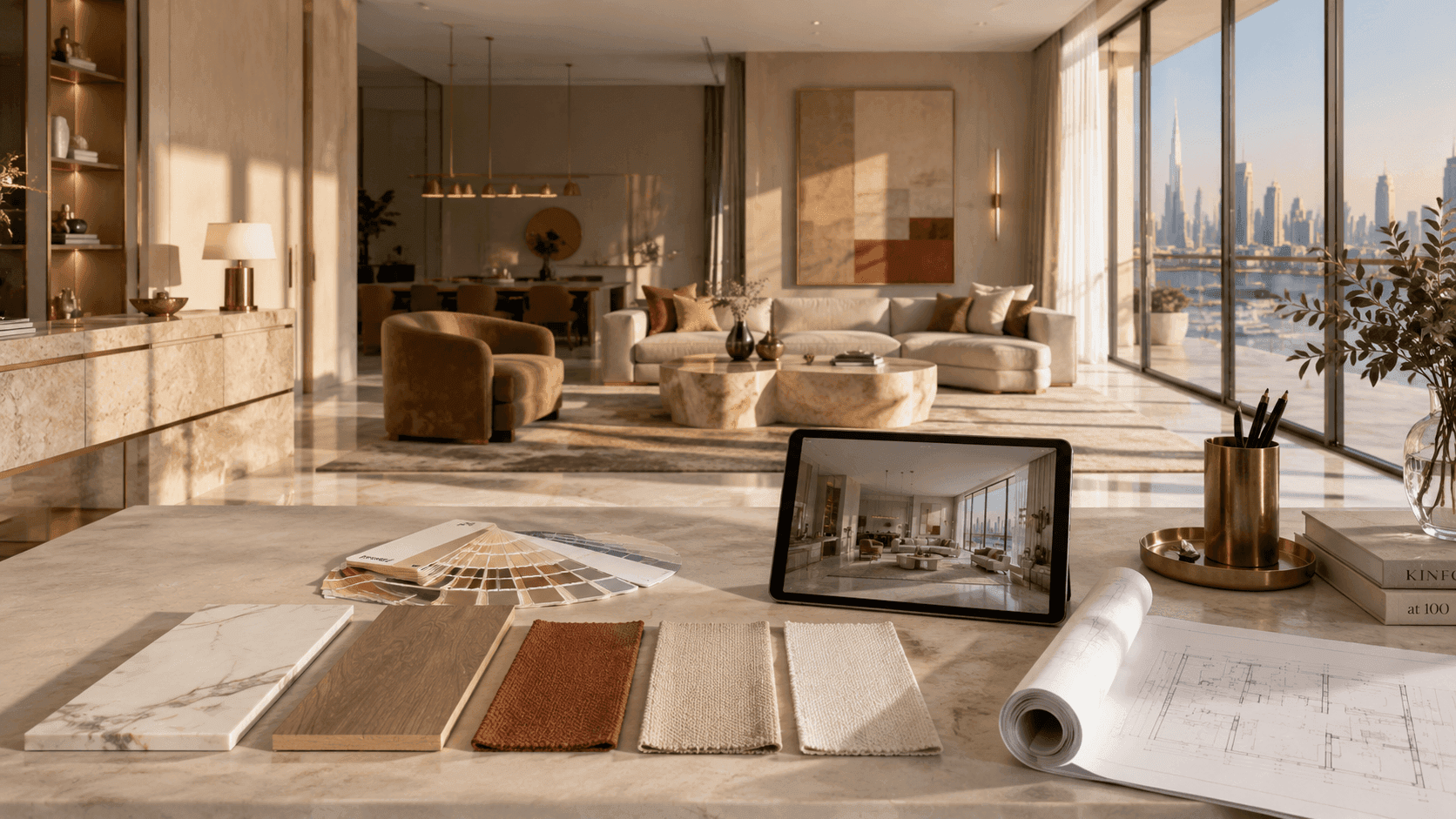
Choosing the right interior designer in Dubai is the difference between a home you genuinely love walking into every day and AED 200,000 of beautifully arranged decisions that don't quite work together. The Dubai market is full of talented designers — and also full of operators with Instagram-ready portfolios that hide poor project management, untransparent fees, and a track record of going 40-60% over budget. Below is the full 2026 hiring guide — how interior designers actually charge in Dubai, the red flags in portfolios, the questions to ask, and what a fair contract looks like.
⚡ Quick Summary
- Interior designer fees in Dubai range from AED 80–500 per square metre (project basis) or 10–25% of total project budget
- Average mid-range 2BR apartment full design: AED 25,000–80,000 (design fees only, excludes furniture and renovation)
- The biggest mistake homeowners make: confusing interior designers (technical + aesthetic) with interior decorators (aesthetic only) — different skill sets, different prices, different outcomes
- The single most common scam: hidden supplier kickbacks on furniture and materials (often 15–30% markup the homeowner never sees)
- Always demand: written fee structure + supplier disclosure clause + 3D renders before any procurement + milestone payment schedule
Interior designer vs interior decorator: a critical distinction
The first decision isn't who to hire — it's what you actually need. Dubai's market mixes these two roles freely, and homeowners often pay designer prices for decorator-level work.
Interior designers cost 2–4 times what decorators charge because they bring technical expertise — drawings, structural understanding, contractor coordination — that decorators don't have. Hiring a decorator for a project that needs a designer is the most common cause of "the look is great but nothing functions properly."
How interior designers charge in Dubai (the 4 fee models)
Dubai interior designers use four different fee structures. Understanding which one you're being quoted is critical to comparing quotes properly.
💡 The hidden revenue most designers don't disclose
On top of design fees, many Dubai interior designers earn 15–30% commission on furniture, lighting, and finishes they source for you — usually from trade-only suppliers who price differently for designers than consumers. This commission is often invisible on your invoice but baked into the supplier's "designer rate."
Sometimes this is transparent and fair (designers earn margin in exchange for sourcing labour). Sometimes it's a 30% hidden markup on every chair, lamp, and rug. Always ask: "Are you taking commissions or margins on the items you source? If yes, how much?"
The 8 things to look for in a Dubai interior designer
Before booking any consultation, screen every designer against these criteria.
10 questions to ask before signing with any designer
✅ The 10-question screening script
- Can you share your Dubai DED trade licence number and a copy of the licence?
- Which of the 4 fee models do you use, and what exactly is included in your design fee?
- Do you earn commissions or margins on furniture, lighting, or finishes you source? If yes, what percentage, and is it disclosed on each item?
- Can I see 3–5 completed Dubai projects from the last 18 months, with building or area names?
- Can I have 3 client references from recent projects, with phone numbers?
- Will you provide 3D renders for every major room before procurement begins?
- Do you handle project management of the contractors building the design, or do I need to hire that separately?
- What is your payment schedule? Specifically, what % is required before any design work starts?
- What happens if the project goes over budget on items you procured?
- What is your revision policy — how many rounds of design changes are included before extra fees apply?
A serious designer answers all 10 with clarity and confidence. An evasive answer on any of these — especially commission disclosure or budget overruns — predicts how the entire project will go.
What you should pay for interior design in Dubai in 2026
Pricing benchmarks for design fees only (excludes renovation, furniture, and materials):
Mid-Range Designer means established Dubai practice with 3–7 years of local experience. Established Designer means 8+ years, published in regional design media, with notable Dubai project portfolio. Top-Tier Designer means internationally recognised, often working with high-net-worth clients on landmark Dubai properties.
Prices reflect 2026 averages and may vary by project scope, designer reputation, and complexity. Design fees do not include renovation construction, materials, or furniture procurement — those are separate budgets, typically 4–8x the design fee.
Red flags in interior designer portfolios and proposals
Beyond the screening criteria, watch for these specific signals in how designers present themselves.
The fair contract structure for any Dubai interior design project
Regardless of project size, a fair Dubai interior design contract includes:
How long does a Dubai interior design project actually take?
⚠️ Anyone promising a full villa design in 3 months is either skipping the technical drawing phase, using off-the-shelf furniture (no custom joinery), or planning to deliver disappointing results. Real design takes time because the alternative is doing it twice.
How to compare interior designer quotes properly
When you have 3–5 designer proposals, comparing them is harder than comparing renovation quotes because the scope varies more. Look at these specific items:
- Fee model — are they all using the same model (per sqm, percentage, hourly, fixed)?
- Number of 3D renders included — typical range is 5–15 renders depending on project size
- Number of revision rounds included — 2–4 rounds is standard, more costs extra
- Drawings included — floor plans only vs. floor plans + elevations + lighting + joinery
- Procurement involvement — sourcing only, sourcing + ordering, or full turnkey
- Project management — included or charged separately
- Commission disclosure — full transparency vs. opaque "preferred supplier" arrangements
- Site visits included — designers should visit site weekly during installation; some quote per visit
💡 The hidden truth about designer quotes
The lowest design fee almost never means the lowest total project cost. Designers who undercut on fees often make it back (and more) on supplier commissions. The honest designer with a slightly higher design fee but full commission disclosure typically delivers 15–25% lower total project cost.
How TaskRight helps
If you'd rather skip the vetting work, TaskRight verifies every interior designer in Dubai before listing them — DED trade licence, portfolio authenticity check, client reference verification, commission disclosure compliance, and recent project quality. AI-matched to your specific project type in under 60 seconds. Zero commission on our side, so you pay designers directly at fair market rates without platform markup.
You see portfolios, real project photos, client ratings, and credentials before you choose. You decide who designs your home. That's the difference between TaskRight and lead-broker platforms that send your number to whoever pays the most.
👉 Find verified interior designers in Dubai →
Frequently asked questions
How much does an interior designer cost in Dubai in 2026?
Interior designer fees in Dubai range from AED 80–500 per square metre or 10–25% of total project budget. A 2-3 bedroom apartment full design costs AED 20,000–110,000 in fees alone (excluding renovation and furniture). Standard villa design runs AED 50,000–280,000. Top-tier designers working on landmark properties can charge AED 500,000–1,500,000+ for large villa projects.
What's the difference between an interior designer and a decorator in Dubai?
Interior designers handle technical work (space planning, drawings, structural input, project management) plus aesthetics. Interior decorators focus only on aesthetic choices (furniture, art, soft furnishings, styling). Designers cost 2-4 times more because of the technical expertise. Hiring a decorator for a project that needs a designer leads to "the look is great but nothing functions properly."
Do interior designers in Dubai take commissions on furniture?
Many do — typically 15-30% on furniture, lighting, and finishes they source. Some designers disclose this transparently; others bake it into "supplier rates" invisibly. Always ask about commission structure in writing. The honest answer is fine as long as it's disclosed. Hidden commissions are the most common interior design scam in Dubai.
What questions should I ask before hiring an interior designer in Dubai?
The most important: Can I see your DED trade licence? Which fee model do you use? Do you earn commissions on items you source — and if so, how much? Can I see 3 completed Dubai projects with building names? Can I have 3 client references with phone numbers? Will you provide 3D renders before procurement? A serious designer answers all of these directly.
How long does an interior design project take in Dubai?
A 1-2 bedroom apartment takes 3-6 months from design start to installation complete. A 3-4 bedroom apartment: 4-8 months. A standard villa: 6-10 months. A large custom villa: 9-15 months. Design phase alone (before any procurement) takes 4-20 weeks depending on scope. Add 1-3 months for furniture lead times if using imported European or Italian brands.
Do I need an interior designer if I'm already hiring a renovation contractor?
For projects under AED 100,000, a strong renovation contractor can manage basic aesthetic choices. For projects over AED 150,000 — and especially anything involving cohesive design across multiple rooms — hiring a dedicated interior designer typically improves the final result by 30-50%. The designer also advocates for you in dealings with the contractor, catching quality issues before they become permanent.
What happens if my interior designer goes over budget in Dubai?
Recovery depends entirely on your contract. A well-written designer contract includes procurement budget guardrails, alerts before any item exceeds budget, and a change-order process requiring your written approval for any overrun. Without these clauses, designers can routinely run 20-40% over budget without breach. The best protection is contractual — get the budget protections written in before signing, not after.
TaskRight Blog
Related reading:
- How to Choose a Renovation Company in Dubai - 2026 Hiring Guide
- Kitchen Renovation Cost in Dubai 2026 - Full Price Guide
- Bathroom Renovation Cost in Dubai 2026 - Full Price Guide
- Red Flag: When Your Renovation Contractor Demands 70% Upfront
- Find verified interior designers in Dubai →
- Best Interior Design Companies in Dubai: How to Find & Verify the Right One
- Interior Design Fit-Out in Dubai Companies Costs and How to Choose
- Red Flag The Hidden Commission Scam in Dubai Interior Design
- Fit-Out Companies in Dubai: Real Costs, Approvals & How to Verify